Jack Harlow is not “getting Blacker”

– 7 min read
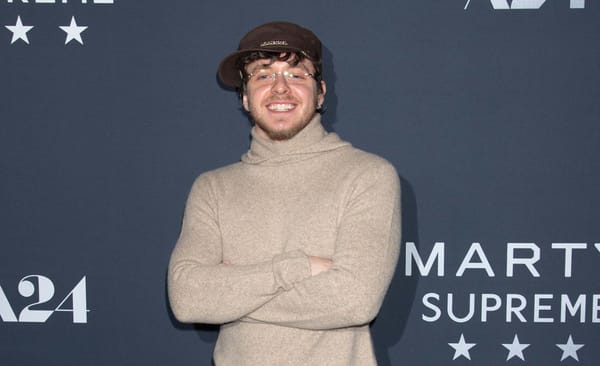
Jack Harlow found himself in hot water after remarks he made on the New York Times’ Popcast. He was there to discuss his latest album, Monica, but a few of the remarks he made during the conversation have kicked off a recurring discourse about cultural appropriation, identity, double standards and what makes a good R&B singer.
Prior to his latest album, Jack Harlow could best be described as a rapper. But we see him making a bit of a departure from that characterization with his new songs and attempting to lean into more of a soulful, R&B persona for this album. Keyword: attempting.
Having seen the conversations and the memes – and oh, just wait until you see the memes – over the last few days, I got curious and listened to a few songs. And what I can say is that the vibe of his new music definitely has potential. But it’s the kind of potential that will really only land with mostly white listeners. And I say that because I’m well aware that society (read: white people) has a strange affinity for mid white artists who amass a great deal of success by making breathy sounds under the guise of it being a tune. There’s a huge appetite for breathy music. What I can’t say is that this music is true R&B, or neo-soul, or almost any of the other genres it’s been characterized as.
And that brings me to Jack’s podcast appearance. Because essentially, the common theme throughout the conversation was about the transition in sound that he made. It was a discussion about his change in direction. It was about, as Jack Harlow, a white man himself, said, him ‘getting Blacker’.
Intellectually, I know that he was referring to his sound when he said this, and not himself as a person. But I also look at the arrogance on full display throughout the interview and conclude that he very well may be conflating his sound and his identity.
His arrogance peaked at one point when host Joe Coscarelli remarked that you ‘can’t talk to Jack Harlow without talking about race’ and his response was ‘I would hope not’, as if he’s some renowned expert in conversations about race. But moments later, he would go on to shy away from a very crucial question about his privilege as a white rapper, while later affirming his understanding of ‘Black politics’.
This is something we’ve seen time and time again from white artists who do everything from imitate Black sounds to profit off it, yet remain tight-lipped during moments that it's actually critical they speak.
I commend the question Joe and his cohost Jon Caramanica were trying to ask, though they seemed to have a hard time getting it out. It was a layered question about whether white artists have an easier time than Black artists moving in and out of genres (which, yes, they absolutely do). And why (unlike other white artists who pivoted into country or rock after being successful in rap, artists like Post Malone and Jelly Roll) has Jack chosen to delve deeper into R&B – or his version of it at least. And rather than answer either question, he said he ‘needed to think about that’ and went on to flip it back on them. At this point, I knew I was done with Jack Harlow.
But then, in the days following his podcast appearance, revelations about the album name started to surface. This was thanks in part to this fantastic essay by W Kamau Bell. He cited an expertly told joke told by comedian Zach Mama about his Black friends ‘misgendering’ him by calling him ‘Monica’.
W Kamau Bell gave the joke his seal of approval despite it being perhaps one of the most dangerous jokes a white man might ever tell. But rather than credit Zach, Jack attributed the album name to simply liking the name Monica. Between the audacity to suggest he was becoming ‘Blacker’ through his music, his refusal to acknowledge his privilege and his refusal to credit Zach for inspiring his album name, I was done done with Jack Harlow.
But it’s not just Jack I’m done with. I’m done with the uneven playing field that exists for white and Black artists – and about how crystal clear that unevenness becomes in interviews and spaces like these. Because why are three white men sitting in a circle to talk about Black music and Black identity with not one Black person in the room?
In a year like 2026, when Miley Cyrus gets to celebrate 20 years of Hannah Montana while Black former child stars have been left reeling from missed opportunities, microaggressions and flat-out racism they experienced when they were younger. And during a time when the ever-traditional Chinese game of mahjong is said to be ‘making a comeback’ because white people in the Midwest are playing it (and white women are designing and selling their own versions of the games, tiles be damned) despite the fact that it never went away among the original players. At a certain point, there comes an overwhelming sense of exhaustion over white entitlement to everyone’s culture and the systems that allow that entitlement to not only prevail, but to be profitable.
This isn’t to say Jon and Joe are not talented music journalists, nor is it to say that Jack isn’t a talented musician, nor is it to say that 20 years of Hannah Montana isn’t worth celebrating, or that white people can’t play mahjong. But it is to say that it can’t be a coincidence that white artists are primed for success in ways Black artists aren’t – and the ones who are primed for that success seem to have the hardest time talking about this disparity despite the dimes they turn off of a sound and culture that doesn’t belong to them.
Reading the coverage of the article in recent days, it is so painstakingly clear who is unfamiliar with true Black music – D’Angelo, Lauryn Hill, Musiq Soulchild and the like – yet writing about Jack’s music like what he’s done is new or original, or even worse – better than all of the legends I mentioned. Take this article I stumbled across on a site called musictalkers.com. It reads:
“It is also a more disciplined record. Harlow set firm creative boundaries while making it, intentionally steering away from ego-driven themes and the kind of lyrical bravado that often dominates mainstream rap.”
You mean, rap by Black artists? Like, this is very rude and insulting. Hello? Also, there are entire subgenres of rap that are the opposite of ego-driven that would still constitute mainstream. This is such an arbitrary take.
“The result is an album cantered on relationships and introspection, presenting him less as a larger-than-life figure and more as someone searching for balance and identity. Reception to Monica has been mixed, with some critics praising its vulnerability and others questioning whether the subdued style fully plays to Harlow’s strengths. Even so, the project marks one of the more deliberate pivots of his career.”
Again, is race in the room with us?
I ask that because in almost every single one of his interviews, Shaboozey, a Black country artist, is asked about race, despite the deep Black roots of country. He is made to answer for the visible difference in his physical appearance and his sound. Yet Jack gets to skirt the questions or have it not be a part of the conversation entirely. What a luxury.
And speaking of luxury, one of the most interesting parts of the podcast actually came right off the top when Jon remarked that when artists make pivots such as these, its usually one of two things. They’re either running from something or running to something. And he said in this case, he did not get the sense that Jack was running from something, but running toward something. And I was struck by how much of a luxury that must be. To be able to confidently go in different musical directions and try things on because you are protected by your whiteness and the ease that comes with it.
And we’ve seen that with artists like Post Malone, MGK, Miley Cyrus, Gwen Stefani, Ariana Grande and Poppy. All of these artists have had the luxury of being able to work through different sounds to find their niche, which, in the grand scheme of things, maximizes their chances of being successful musicians. That same luxury doesn’t exist for Black artists. And a perfect example of that is the hell that Beyoncé, one of the world’s most legendary, decorated icons, had to endure in putting Cowboy Carter out.
So I think it makes sense that instead of the much-warranted anger and exhaustion we might expect from Black people at a time like is, we’re seeing a lot of laughter and a lot of memes in the collective Black response. Here are a few of my faves:
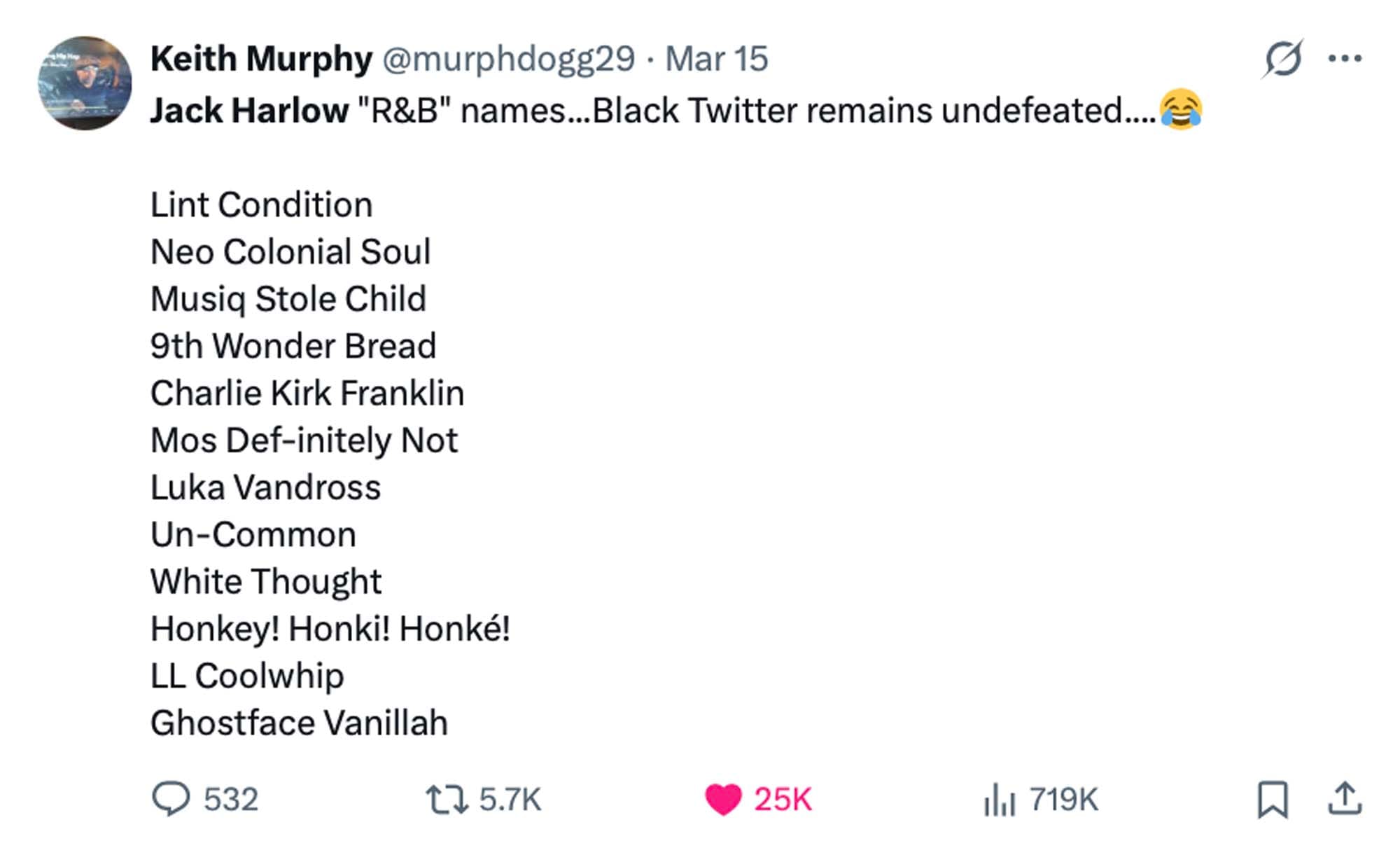
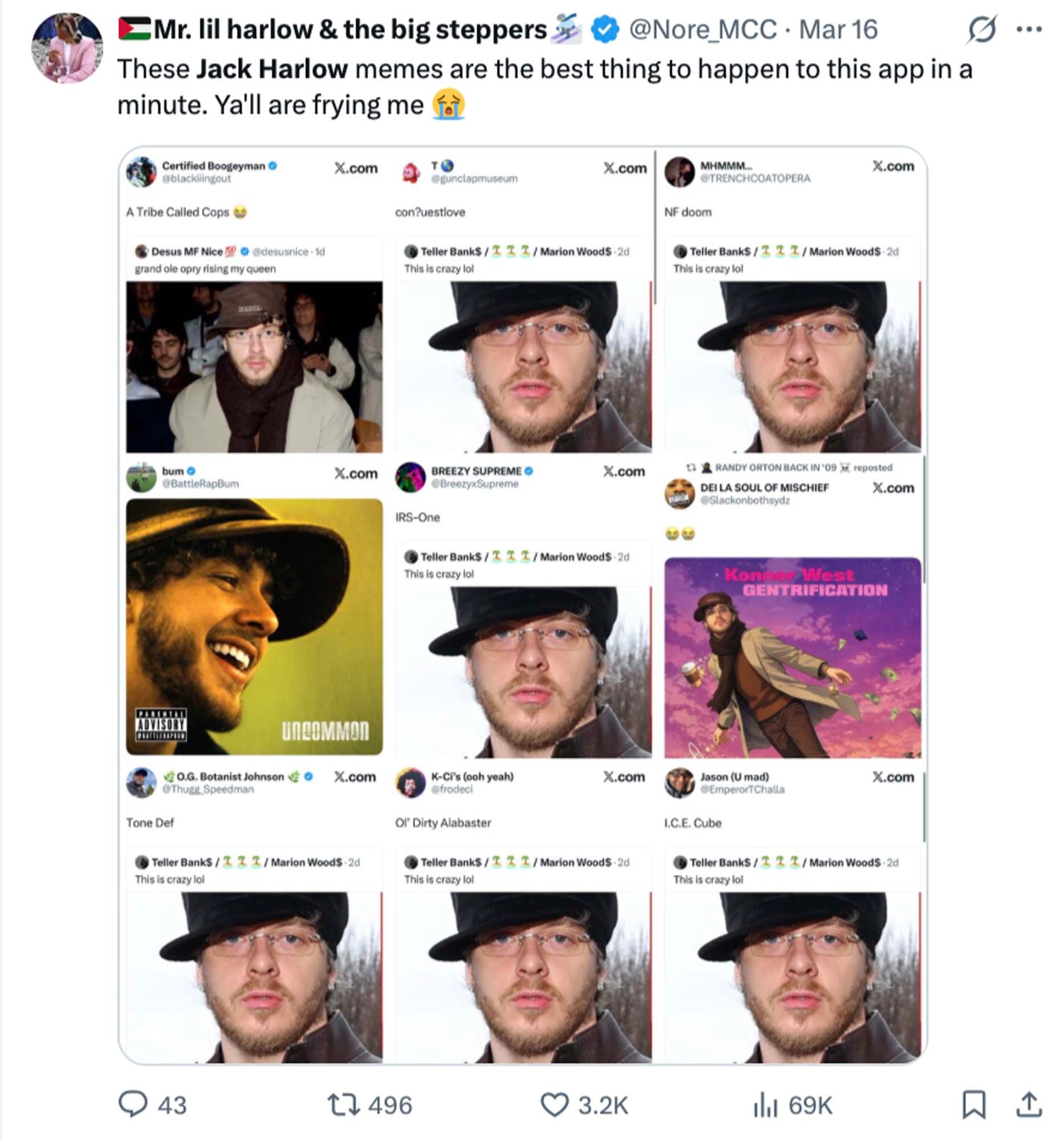

Memes in response to Jack Harlow
Is it upsetting? Yes. Tiring, even? Absolutely. But is it going to change? Honestly, probably not. Because we cannot do the job of holding artists to account when there are larger systems in place that not only allow, but encourage and allow it to be profitable, while our only form of repayment is the shuffling off of conversations about race and naming the album after an n-word joke. At this point, it’s clear Jack Harlow is making ‘Black’ music for white people who don’t know what true Black music is.