Intro for August 4, 2026

– 3 min read

Dear Gossips,
I’m usually the one to bring new music into the house. Once every ten years, though, my husband Jacek will find an artist or a song before I do – and it almost always happens through videos games. Nowadays he only plays one, consistently, year after year: EA Sports FC, formerly EA Sports FIFA. Every year upon release, the game has a new soundtrack, and a few years ago, Jacek heard an artist through the game who has become one of his favourites.
So he’s the one who started listening to Sam Fender’s album, People Watching, when it first came out in February 2025. And that’s why “People Watching”, the title track, was featured that week in the Music Lounge column when I then suggested it to Michael.
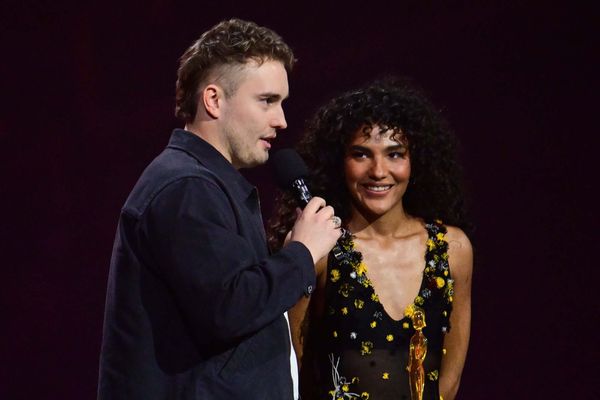
People Watching, then, has been playing for nearly 18 months at my house because of Jacek. Which is why I’m very familiar with the song that just made history in the UK after spending 19 weeks on top of the charts since Jacek has it on repeat: “Rein Me In”, both the original and the version that features Olivia Dean which was added in June of 2025 and over the last year has been slowly gaining momentum and popularity in the UK, hitting #1 in February of this year (so a full 12 months after Sam released his album) and retaining its dominance ever since.
This past weekend, Olivia headlined Lollapalooza and brought Sam out with her to perform their megahit in Chicago. And OMG they sound so great together live.
I’m sure Olivia’s fans know the song really well. But the truth is… “Rein Me In” has not really crossed over in North America. As Billboard just noted last week, it hasn’t even cracked the top 40, dropping “from its No. 64 high point to No. 73 [on the most recent chart]. Part of the problem is that two other Dean hits simply refuse to yield: “Man I Need” (which holds at its No. 2 peak) and “So Easy (to Fall in Love)” (which keeps at its No. 6 high). Both are catchier and closer to the core sound in pop music right now.”
“Part of the problem”? Is there really… a problem? Are we seriously calling it a “problem” when a song is huuuuge but not in North America?
And also, what exactly is the “core sound in pop music right now”? Well, that’s where they tell them on themselves, non? Even when we’re talking only about pop music that’s performed in English, they’re exposing how they are CENTERING where that music has to come from. But also, even if they were to extend the boundaries of that center, they would likely tell on themselves again because, like, are the Grammys going to introduce a new category for “Pop Music from the UK”?
Olivia, obviously, is one of the biggest artists to emerge in the last couple of years. And she’s still on the rise. She’s on tour right now, in Toronto tonight where I live for two shows at Scotiabank, which is an arena. To be clear, I mean no disrespect, I love her. She’s playing sold-out arenas now because she’s still ascending, there’s a higher summit for her as an artist, she’s now just on her second album cycle, so eventually with more releases, she could become a stadium artist, which is typically the next level.
But my point is about perspective. And whose perspective gets to shape, and then is presumed as a cultural standard. The biggest band in the world, BTS, has long outgrown arenas because they’ve been doing this for over a decade. And can still sell out stadiums around the world, enormous ones like Stade de France in Paris, with over 90,000 people even after a four year hiatus while performing over half their setlist in Korean. Why, then, should their music be segregated at the Grammys when for those who are filling those stadiums, their songs are the “core sound in pop”? When a song like “Rein Me In” has broken records and been #1 for 19 weeks, and a major music publication calls it not the “core sound in pop”, isn’t that yet another example that a “core sound” is arbitrarily designated by certain gatekeepers with a music focus that is increasingly narrow?
Yours in gossip,
Lainey