Kendrick reflects on his culture and victory

– 5 min read

Just months after a very high-profile rap beef with Drake, Kendrick Lamar is cementing himself as a few things – a deeply reflective and vulnerable man, a musical and lyrical genius and of course, the true victor of the spat that saw the two releasing diss track after diss track, which climaxed when Kendrick dropped ‘Not Like Us’ earlier this year.
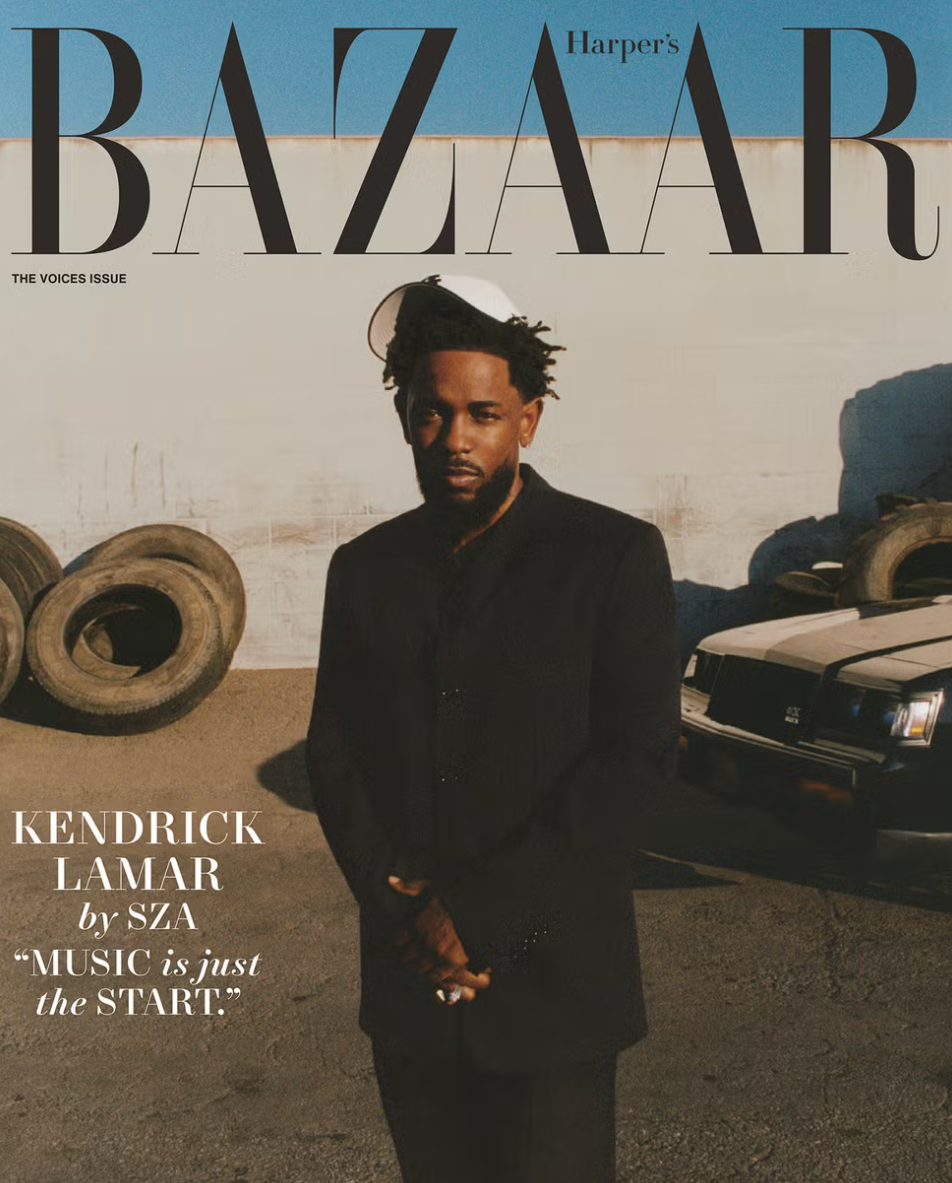
This week, Kendrick became only the fifth man to be featured solo on the cover of Harper’s Bazaar. And this comes just months after it was announced he would be headlining next year’s Superbowl, arguably the biggest event in sport, save maybe for the Olympics.
Kendrick certainly slayed the cover. But on top of providing us with noteworthy visuals for the latest issue of the magazine, it’s really the story, expertly extracted from the depths of his soul by none other than SZA and writer Kaitlyn Greenidge, that’s showing us all the person he is outside of his music, though who he is as a person and who he is as an artist are so closely interwoven that you can’t really see one without the other, even though he revealed he makes a conscious effort to do just that.
“I’ve learned that I can’t identify with my performances onstage. I can’t hold my true identity to that person who’s onstage…if I did, that means I will judge every movement every time I f—k up a lyric, every time I’m off-key…I have to have a distance between the performance and the person I close my eyes and look at the ceiling with.”
The interview is full of insightful glances into Kendrick’s sense of self. The ease and flow of the conversation makes so obvious the sense of comfort and familiarity between Kendrick and SZA, who were once signed to the same label and joined forces for ‘All the Stars’, a song that appeared on the Black Panther soundtrack.
Reflecting on his spirituality, Kendrick says that running has helped him connect to God, who he believes he has conversations with “all day, every day”.
“There was this threshold of pain in the spirituality for me. I remember my shins was aching and I was like, I got one mile to go. Then I get whispers and downloads and start talking about sh-t that I want to know about.”
He goes on to say that these experiences are what push him to go the extra mile, literally. Everyday, he says he’s able to make it three or four miles into his run because he turns to God. He’s acutely aware of how this sounds and acknowledges that there are times that even he has questioned his sanity. But it’s that level of honesty that makes learning more about this side of him so refreshing. Because it’s not everyday that one of the world’s greatest rappers opens up about his morning runs, their relationship with God, or the struggles they faced in childhood. But when you listen to his music, it makes total sense that this is who he is, because his music is infused with that same raw honesty, that same vulnerability we see throughout the interview.
When it came to his childhood, Kendrick immediately remarked about the difficulty he has discussing it. He told SZA that he “hates going back to that”, calling it “traumatizing”. He cites having a militant father and tough expectations as part of the reason before getting into what it means to “be a man”.
The household dynamic that Kendrick is describing of growing up in a home with a non-emotive father and having to check himself on the fact that he was subconsciously adopting a lot of those characteristics is likely what makes his music so relevant for people that have been listening to him since his early days. I’d also argue that it’s part of the reason why he was able to come out on top in his spat with Drake this year.
Despite their war of words making headlines everywhere earlier this year, including the BBC (?), this wasn’t just simply a rap battle. This was a battle of culture. And the reason Drake didn’t stand a chance against someone like Kendrick, whose Compton roots and tough upbringing enriched his approach, lyrics and artistry, is because try as he might, Drake’s background, Drake’s upbringing, does not reflect the experience that makes up so much of the heart and soul of rap in the way Kendrick’s does.
When you compare Drake’s background to that of a rapper like Kendrick or Pusha T, the latter of whom we can all thank for letting us know that Drake is a dad, the competition is stiff. From politics to anti-Black racism, within their music, we get to know these men and the struggles they’ve faced and overcome. In Drake’s music though, we learn mostly about his views on love, women and heartbreak. There’s a huge difference in subject matter.
In a rap beef, the emphasis is not on whether your song will get asses shaking or hands in the air. It’s about how well you’ve obliterated your opponent. So the fact that Kendrick was able to get asses shaking and hands in the air and obliterate his opponent with ‘Not Like Us’? It was a true disaster for Drake, despite rumours of him strategically planting fake information and the idea of there being a mole, and a bunch of other hoopla that gripped those following the spat. It was so disastrous that he played Kendrick’s hit at his own concert – which, despite attempts from fans to spin this as him “trolling” Kendrick, was more like him waving a white flag.
When asked what the song represents to him, Kendrick had this to say:
“‘Not like us’? ‘Not like us’ is the energy of who I am, the type of man I represent. Now, if you identify with the man that I represent …This man has morals, he has values, he believes in something, he stands on something. He’s not pandering.”
It’s unclear whether his response was a direct shot at Drake, one that suggests that unlike him, Drake is pandering. But having had his character, his fatherhood and his integrity under attack in previous rap beefs, coupled with his mainstream success, one could easily assume that Kendrick is suggesting that he is the opposite of Drake – hence the title, “not like us”.
I mentioned a sense of comfort and familiarity between Kendrick and SZA, and for people that share elements of Kendrick’s background, that sense of familiarity and comfort echoes in his music. And while there are a lot of people who can relate to Drake’s songs about love and heartbreak, Kendrick dropping ‘Not Like Us’ was almost a reminder of what real rap sounds like. More importantly, what it feels like.
It's both ironic and iconic that after this beef, it’s Kendrick’s career that is taking the turn that it is, despite Drake being the bigger ‘mainstream’ celebrity. And Kendrick’s ability to remind us what real rap feels like is why at a June concert that was only announced less than two weeks prior, 'The Pop Out: Ken & Friends', he performed the song five times back-to-back, with the crowd reaction becoming more and more hype each time. From his friends in the NBA to everyday fans that had been rocking with him for years, this was the year that Kendrick reminded us all that for him, it’s not just music. It’s his culture.
Click here for more of Kendrick in Harper's Bazaar.