Keke Palmer’s KeyTV misfire

– 7 min read
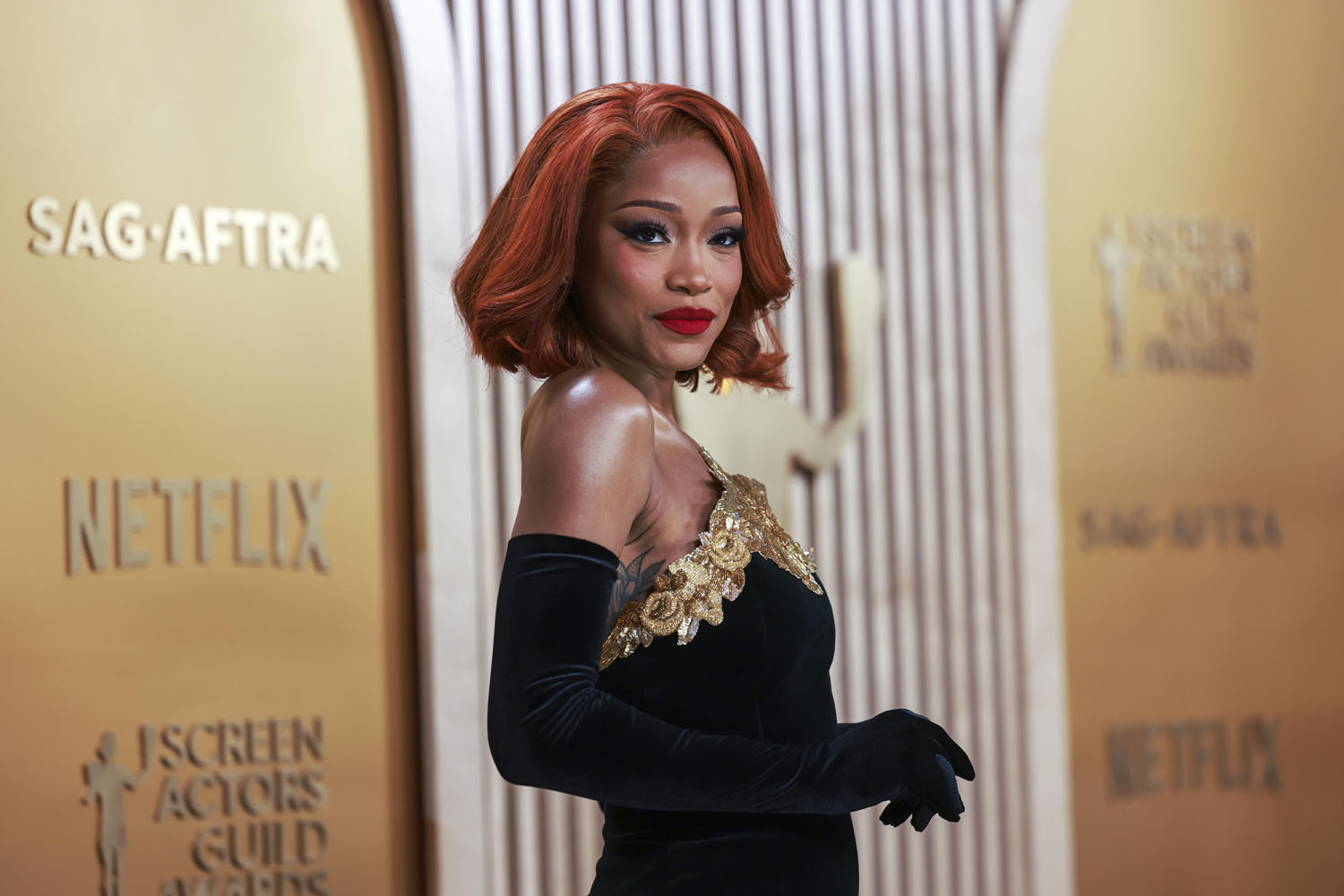
Keke Palmer and her digital network, KeyTV, are at the centre of what has become an increasingly heated discourse online after the release of a show called Southern Fried Rice. The show, which Keke described as a ‘coming-of-age dramedy’, follows protagonist Koko Johnson, a Korean-American woman who was adopted into a Black family and is navigating her freshman year at a fictional historically Black college (HBCU) in Atlanta.
As you may recall, Keke launched KeyTV in 2022 to spotlight marginalized voices and amplify access and opportunities for emerging artists in entertainment. But people online are not having it – and the reaction to the show on social media has been anything but warm and receptive, which is an atypical response for Keke in particular.
Keke’s popularity has been steadily growing over the last few years. She has long been appreciated for her candour, her many talents and her chutzpah. But the cold reception to the show indicates there were some pretty big missteps in the creation, production and execution, so what went wrong along the way?
The issues people have with the show are extensive, but center mostly around the creative decisions that were made by show creator and writer Nakia Stephens. Critics have highlighted how the show perpetuates dangerous and stereotypical portrayals of Black women. But the biggest issue people seem to have with the show is the decision to tell a non-Black story in a setting that is practically sacred for Black people.
In recent days, both Keke and Nakia spoke out about the chilly reception to the show. In an Instagram post, Keke had this to say:
“Look, what you like is subjective, but the support of Black creatives is not…So, whether you like it all or some or none, I say give these creators a chance to grow as we continue to grow in supporting them.”
Nakia was also speaking up in defence of the show until she deactivated her account on X in what I can only assume was in response to the backlash. This included people digging up questionable tweets from her past. The old tweets from the early 2010s seem to paint the picture of someone who was very invested in what I can only describe as Asian approval.
It's not always problematic to have a fascination with another culture, especially considering she lived abroad and studied in Shanghai. But in a series of tweets, she expressed excitement over favourable responses from Asian people to things like playing Dance Dance Revolution and planning a trip to China, which, upon mentioning, earned her 15% off of whatever she was purchasing. I wish I was kidding.
According to the discourse since the show’s release, people are speculating about whether Nakia was dishonest about her ethnicity, claiming to be mixed Dominican and Asian, despite also sharing photos of her parents who appear to be full Black. To contextualize this, this kind of deceit pads the case for people alleging that the choice to tell this story through an Asian lens is rooted in her discontentment with her Blackness, and that’s an incredibly dangerous place to tell Black stories from. It’s kind of like what I wrote about last week with Tyler, The Creator making music from a place that was, in the early years at least, very anti-Black. So who is the audience? And who is telling the story?
Before leaving the platform, Nakia tried to make her initial intent with the show clear:
“I wanted to tell a story that speaks to what it feels like to exist between cultures — to love where you come from while still figuring out where you belong.”
And she wanted to make it clear that, despite the protagonist being non-Black, a majority of the staff were.
“It’s literally a Black show produced by Black people. You call to ‘cancel’ an indie show that employed hundreds of Black filmmakers, stars 99% Black people, and [is] powered by Black women.”
While I can appreciate the sentiment behind what she’s saying, I also think that highlights part of the problem. If the show was produced entirely by Black people – wouldn’t it make sense for the protagonist to also be Black? Especially considering the amount of invisibility and erasure Black creatives already deal with?
According to Nakia, the show was ten-plus years in the making. And I think for a lot of people, that just adds insult to injury. Because so much has happened over the last decade to strengthen the case for platforming Black protagonists and Black stories, namely the cancellation of many shows that were greenlit in the wake of 2020 only to be quietly discontinued when support for DEI dwindled, which I touched on here – yet they still went in this direction.
None of this is to say that there is no need for more shows with Asian protagonists. But we need to be doing this in a meaningful way. And the Southern Fried Rice storyline is so far from believable that it’s not just falling flat with its Black audience, but its Asian audience, too. Asian content creators have taken to TikTok to express their confusion with the show’s premise.
This image, which speaks for itself, went viral over the weekend, garnering almost 4 million views on X.
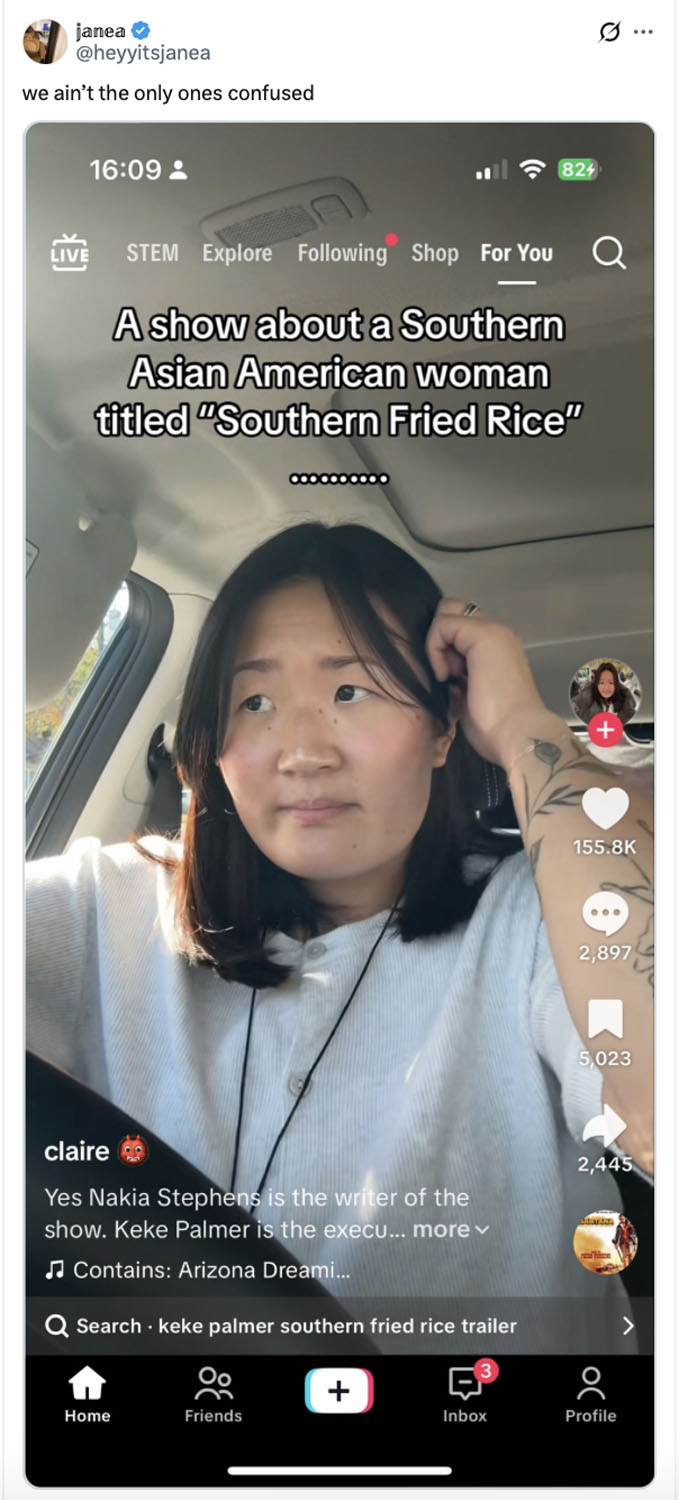
And this TikTok creator pointed out the lack of believability in the storyline in a video where she asks people to put up a hand if they know an Asian person who was adopted into a Black family and attended an HBCU.
And this user pointed out the issues with the show name, Nakia’s problematic behaviour on social media, and the cry from some Black artists over the lack of interest from the audience.
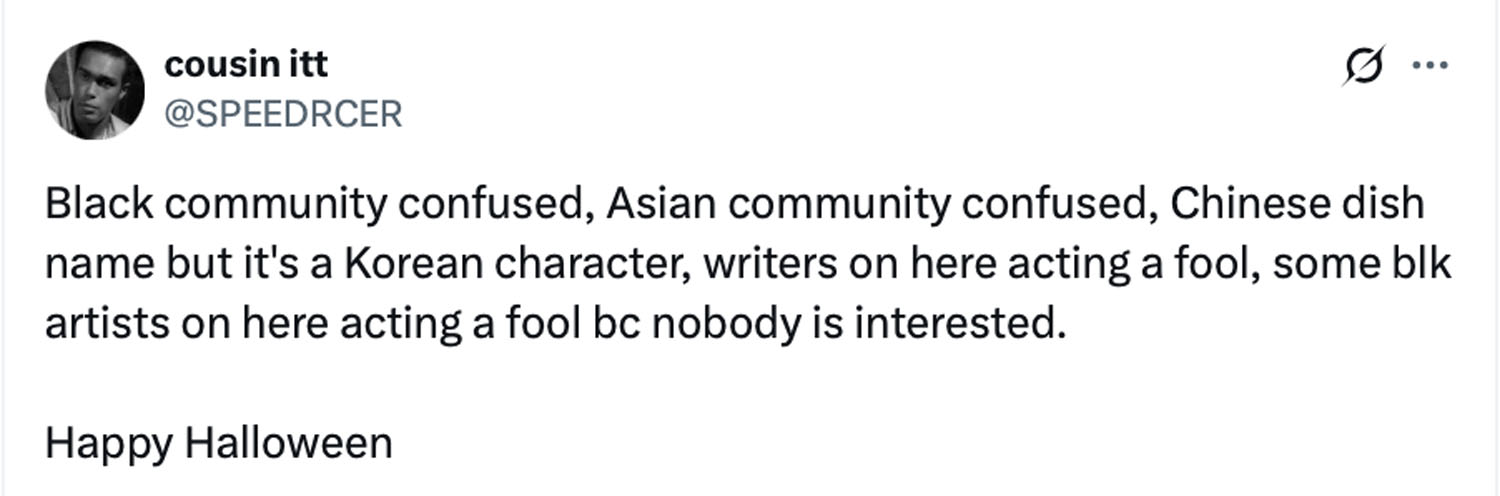
To that user’s point, Black artists calling on Black audiences to be more interested in Black art is an idea worth exploring. Do we have to be interested and supportive of content just because we share aspects of our identity with the person or team behind it? It’s a question worth asking, considering that Black creators can and have contributed to negative, stereotypical or internalized portrayals of Black people, namely Black women, which makes the mere act of supporting their work incredibly difficult and nuanced.
People pointed out that in the show, Koko’s best friend is a Black pregnant teen who never went to college. One of the roommates plays the role of the ‘angry Black woman’ and there’s a fairer-skinned woman who shows Koko kindness. All of these are dangerous tropes – and we see these all the time, even in productions by Black people. Despite Tyler Perry’s historical success, he is known for his problematic and polarizing portrayals of Black women. I’ve written about that in the past. And users made sure to mention him in the discourse.

As I mentioned, the biggest issue people seemed to have was telling a non-Black story in an HBCU, one of the very few spaces in academia designated for Black people. While HBCUs aren’t really a thing in Canada, these institutions – which include colleges like Morehouse and Spelman and universities like Clark and Howard – are known as places where Black identity is formed and celebrated for Black Americans. Southern Fried Rice is far from being the first show to be filmed in this setting. The iconic hit show A Different World followed the lives of students at Hillman College, a fictional HBCU inspired by Howard University. And movies like Drumline, School Daze, The Great Debaters and Stomp the Yard all took place in HBCU settings.
Overall, there’s a culture of protection surrounding storytelling when it comes to HBCUs. And while a lot of that has to do with the sacred nature of these spaces, it also has to do with the very real impact that stories told in this setting can have. Last year, Howard University celebrated the cast of A Different World decades after the show aired, crediting the production with getting people to ‘fall in love’ with HBCUs. To this day, the show is credited with increasing awareness and enrollment for HBCUs across America. The show is said to have inspired more students to choose HBCUs for their college experience.
According to a CNN report, HBCU enrollment increased by 26% between 1976 and 1994 – with the increase concentrated between the years of 1986 and 1994, which coincides with the show being on air from 1987 to 1993. So in choosing an HBCU as backdrop for this show, there was a hope that this story would be told responsibly, and from almost any angle you look at it, it simply was not.
All of this underscores the dangerous idea that Black stories cannot exist independently and must be told through a lens other than one of Blackness in order to be impactful. But what that’s saying is that creators would rather pander to different audiences than make a meaningful show for Black consumers, which is precisely the point of KeyTV.
To counter this narrative, social media users have used the traction this conversation is getting to promote shows that responsibly tell Black stories, like G.R.I.T.S and Forever, Black protagonists and Black love and all.
One of my favourite sidebars of this conversation has been people exploring what the show could have been. Someone suggested the show would be ‘more interesting and less controversial’ if the lead was half Asian and half Black and was learning to navigate both aspects of her identity. And I like that conversation because it shows the appetite, the creativity and the capability to create meaningful Black content. Hopefully Keke is paying close attention.