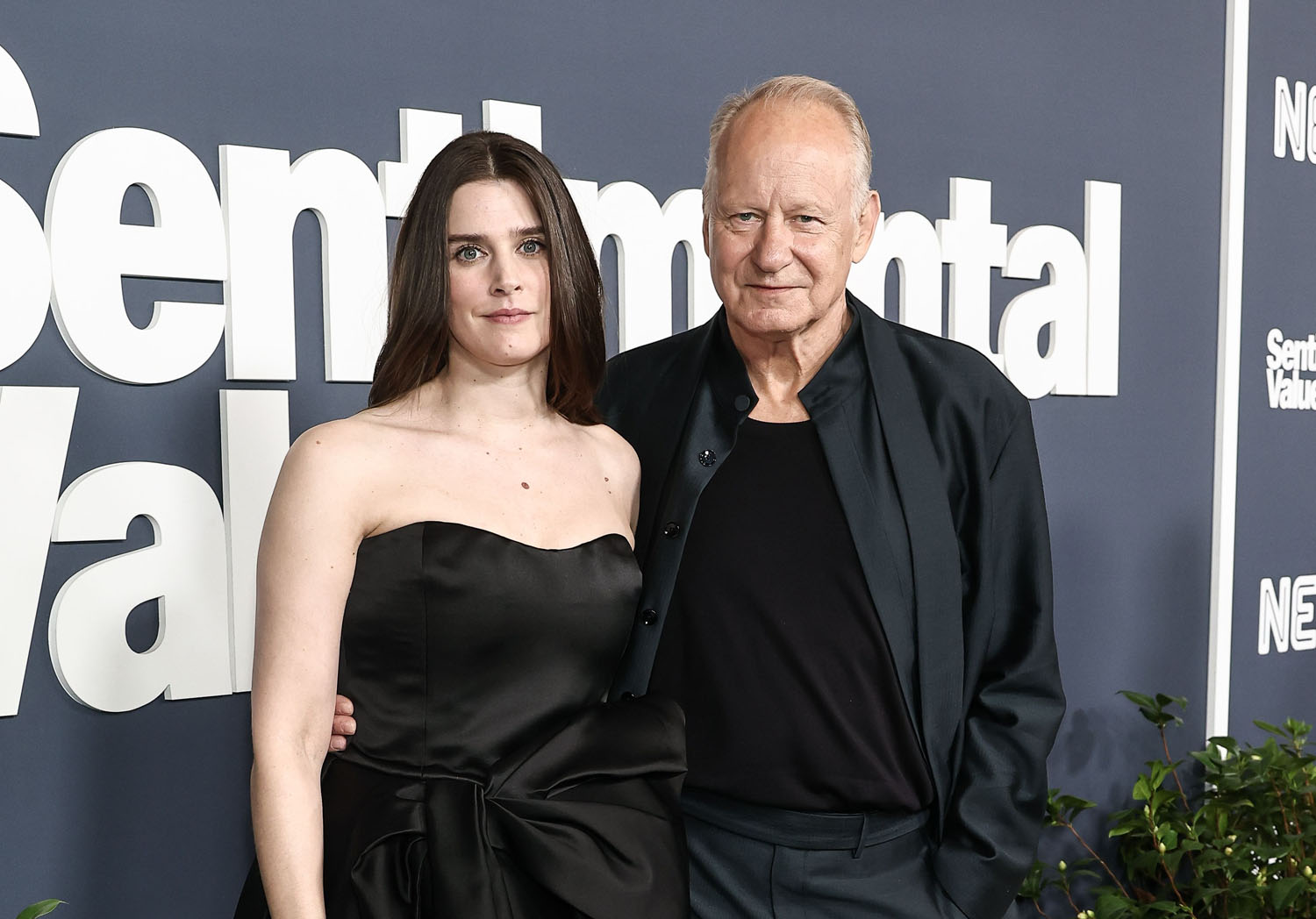
Renate Reinsve and Stellan Skarsgård in Sentimental Value

– 5 min read


Norwegian actress Renate Reinsve’s feature film debut was in Joachim Trier’s 2011 film Oslo, August 31st, the second film in the filmmaker’s “Oslo” trilogy. Ten years later, the final film in Trier’s trilogy, The Worst Person in the World, gave Reinsve her international breakout role. Now, the duo reunites once again for Sentimental Value, a luscious family drama-comedy (in that order) about generational trauma, absence, and forgiveness.
Reinsve stars as Nora, an actress who works primarily in theater, which her filmmaker father, Gustav Borg (Stellan Skarsgård) cannot sit through because of the lack of, well, cinema. It’s the same for an unnamed television series that has brought Nora some success, he can’t finish it because there are “no visuals”. We learn from the opening of the film that Nora and Gustav are estranged, but Gustav seems to make little effort to heal the breach.
Which explains at least some of Nora’s anger. She describes herself as “80% f-cked up”, suffers nearly debilitating stage fright that requires theater crew to physically restrain her before releasing her onto stage, and she sleeps with a married coworker because their extramarital affair requires no commitment or emotional investment from her. Nora does not hide her flaws, and she seems to have a pretty good grip on her own issues, laying them at the feet of her estranged father. Upon divorcing her mother, Sissel, Gustav went to Sweden and never really came back until Sissel dies.
Alongside Nora is her sister, Agnes (Inga Ibsdotter Lilleaas), who once acted in Gustav’s films as a child, but as an adult lives a comparatively sedate life, raising her son and occasionally doing historical research for her father. Through their loose working arrangement they have gained an understanding Gustav lacks with Nora, though he returns to Norway bearing a gift—a script he has written for Nora. Incensed, she rejects the offer to collaborate and then watches as her father strikes a deal with an American starlet, Rachel Kemp (Elle Fanning), to make with movie with Netflix.
What makes Sentimental Value tick is the slow peeling away of layers in the Borg family. As a child Nora perceived the family home as a presence watching her family pass through its halls in successive generations. The home, a charming Victorian, is full of character and quirks, including a crack slowly destabilizing the foundation, an unsubtle metaphor for the emotional quicksand on which the Borg family stands. As Gustav labors to bring his film to life, we learn the history of the house, including the fact that Gustav’s mother died by suicide in the sitting room. Gustav’s film is written for Nora—it is, as Agnes says, about her—but it is also about Gustav unpacking his mother’s death sixty years down the line.
None of the pieces of the Borg family are separate, they overlap and echo through that quirky house. Nora can no more sever herself from her father than he could from his mother, and they’re both trapped in the same angry, disappointed relationship with an absent parent. But Gustav and Nora have a chance to mend their rift, and they stumble toward understanding in a series of fits and starts. You can feel the absence of Sissel, a therapist who might have been able to talk her ex and her daughter through a reconciliation, but instead they must rely on cinema and performance to understand one another. It is an imperfect system.
Trier, once again collaborating on the script with Eskil Vogt, does not try to say cinema can heal all wounds. Art and expression are important, and it provides a common language for Nora and Gustav, but Trier is realistic and even comedic about the limits of cinema, especially in this day and age. Gustav struggles to secure financing, all his friends and collaborators have gotten old when he wasn’t looking, and his daughter refuses to even read the script he wrote for her. But the film keeps him in Oslo, in the orbit of Nora, as does the house, which Agnes and Nora slowly pack up after Sissel’s death and Gustav occupies as if it isn’t haunted by the worst moments of his personal history.
Sentimental Value isn’t the kind of film that crescendos into grand declarations and sweeping emotional catharsis, though it does provide its own quietly satisfying release. The rift between Nora and Gustav won’t heal all at once, as the damage was inflicted, it will take time and many attempts for the Borg family to reconcile. But the film offers hope that reconciliation is possible—though there is something impossibly precious about that message centering on a successful artistic family, which describes a vanishingly small number of people—if we can just find the doorways that connect us. Cinema is a doorway between Gustav and Nora, and Gustav and his mother, and it’s through cinema they stumble their way toward understanding. And it is the house, the imperfect foundation of their family, that gives them the space to find each other.
Sentimental Value will play exclusively in theaters from November 7, 2025.