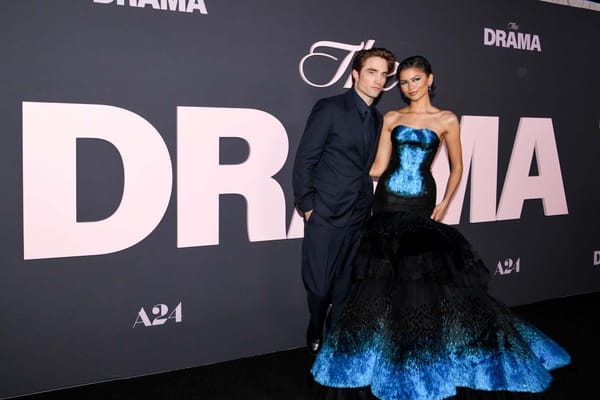
Robert Pattinson and Zendaya in The Drama

– 7 min read
This review contains major spoilers for ‘The Drama’. Sorry, there’s no way to review this film without getting into it. Spoiler culture is strangling good criticism, and ‘The Drama’ doesn’t even have a plot twist, the entire plot is predicated upon a secret, that is different from a twist, which prompts the plot to sharply diverge from the established narrative arc. The plot of ‘The Drama’ never diverges, it proceeds logically from the critical revelation, which is a plot POINT. Anyway! Onto ‘The Drama’.
Norwegian filmmaker Kristoffer Borgli loves an absurdist take and a dark plot, and his latest film, The Drama, is a darkly absurdist take on a romantic farce. Zendaya and Robert Pattinson star as Emma and Charlie, a seemingly “perfect” couple engaged to be married. During a dinner with their friends Rachel (Alana Haim) and Mike (Mamadou Athie), who are serving as their maid of honor and best man, respectively, Rachel pushes everyone into revealing their darkest secret. Mike shares that he used a former partner as a human shield during a dog attack, Charlie bullied a classmate so badly the other boy’s family relocated, and Rachel locked a child with a disability in a closet and essentially left him to die. That the child did not die is no thanks to Rachel.
Emma, meanwhile, who is from a lower-class background than Charlie and is also biracial—Rachel and Charlie are white, and this will matter later—reveals that she once planned a school shooting, going so far as to obtain a gun and record a manifesto. In fact, she is deaf in one ear not because she was born that way, as she originally told Charlie, but because she blew out her eardrum holding the gun too close while shooting it. Emma also reveals that circumstances in her community, and connecting to others after a similar tragedy, convinced her to cancel her plans, and years later, as an adult, Emma has moved on from her teenaged destructive episode. But she obviously carries a lot of guilt and shame over her intentions, though she never acted upon them.
Rachel is intensely horrified, and what follows is a social-romantic farce about betrayal, hypocrisy, and the limits of love—or it would be if Borgli had a better grasp on his own script and its themes. But there is a gulf between the story as Borgli presents it and the one that unfolds due to Rachel’s obvious villainy, weaponizing her white womanhood to other and punish a Black woman who has “landed” a “good catch” in Charlie. Borgli never seems conscious of the racial and class implications of Rachel, a privileged white woman, using Emma’s own shame against her to try and ruin her relationship and have Emma ejected from their friend group.
Rachel is recognizable as a specific kind of neoliberal white woman, an upper-class daughter of privilege who cannot possibly be racist because she dates Black men but never considers what her viperous reaction to Black women reveals about her. She is also objectively worse than Emma, who essentially reveals a troubling mental health episode from her childhood, yet one that did not result in actual, lasting harm (except to herself, through hearing loss). Rachel, however, fully tortured a child, nearly killing him, and yet does everything in her power to convince her social circle that Emma is the monster.
Alana Haim’s performance is so specific, her recounting of Rachel’s terrible deed so riotously funny, that it seems Haim, at least, understands all the intersectional gendered, racial, and class dynamics at play between Rachel and Emma. Haim plays Rachel as the real villain of The Drama, an unchecked monster confident in her ability to shift blame onto others she perceives as less than herself. I’m just not sure Kristoffer Borgli understands that, too. Haim’s performance offers layers and connections that ultimately don’t lead anywhere because the story itself is not meeting her effort, ultimately stranding Haim’s brilliant bitch performance with nowhere deeper to go.
The other actors are similarly stranded. Zendaya and Pattinson give solid performances, but they are never able to connect to that deeper layer, where the true subversion of The Drama lives. Borgli thinks it’s about love and hypocrisy, and that Emma and Charlie are meant for each other because they accept each other’s worst flaws—without acknowledging that Charlie is objectively worse than Emma, too—and most of the cast perform their roles aligned with that intention. But The Drama, were it actually as subversive as it thinks it is, should be about how white people will co-opt trauma in order to secure and reinforce a supremacist social order. Again, Rachel to the fore, as she claims she is in part repulsed by Emma because Rachel’s cousin was paralyzed in a shooting, yet it is abundantly clear the cousins are not close. Her cousin’s trauma is simply another shield for Rachel’s own moral vacuity, and a weapon she can use against Emma in their social circle.
There are a lot of enjoyable elements of The Drama. Some of the dialogue is genuinely funny, the way social situations unravel is also very funny, the performances are good. But the film is thematically confused, and unfortunately, it’s confused in a way that cheapens the attempt at subversive humor. It fails in its intentions because the intentions are never clear. Or perhaps, they’re simply not the right intentions. I wonder if Borgli ever considered how casting a biracial actress as Emma would change the Rachel-Emma dynamic. Alana Haim certainly seems keyed into Rachel’s true racist repugnancy, and Zendaya portrays Emma as a woman conscious of how her race amplifies negative perceptions about her, but these facets of their performances don’t connect with each other or Borgli’s larger themes.
Sarah! Not everything is about race! Well, it is in this film, in which a working-class Black woman is punished and socially ostracized for what boils down to a mental health crisis, while multiple privileged white characters literally get away with actual, life-ruining behavior. There is simply no ignoring that Emma is vulnerable to Rachel’s social agenda because she is already Other in Charlie’s world—poorer, less educated, and Black. She has less defenses from Rachel’s WASP attack, and less people willing to help her.
(There is also an entire subplot about one of Charlie’s female co-workers accusing him of sexual assault after they kiss which is an extremely poorly considered anti-#MeToo take that, as several recent films have done, positions women making workplace harassment claims as instances of regret or even outright manipulation. Why are so many white male filmmakers interested in workplace harassment being an issue of female agendizing? Much to consider!)
But The Drama is the kind of imperfect film that rewards viewing simply for the ways its imperfections reveal narrative mechanisms and intentions. This is a film that invites conversation, not because it is thought-provoking, as it intends to be, but because its flaws create completely different conversations about casting, performance, and meaning. The Drama is not the film anyone thinks it is, from Kristoffer Borgli to the individual actors to the audience, but it is an interesting failure of intention. There is also Alana Haim’s superb performance, which is a sharply observed embodiment of white woman victimhood. Truly “villain of the year” stuff from Alana Haim.
The Drama is now playing exclusively in theaters.


Robert Pattinson and Zendaya attend the premiere of A24's "The Drama" at Regal Union Square on April 02, 2026 in New York City


Robert Pattinson and Zendaya attend the premiere of A24's "The Drama" at Regal Union Square on April 02, 2026 in New York City


Alana Haim and Mamoudou Athie at the New York Special Screening of "The Drama" held at Regal Union Square on April 02, 2026 in New York, New York