Zoe Kazan’s East of Eden stands on its own

– 5 min read
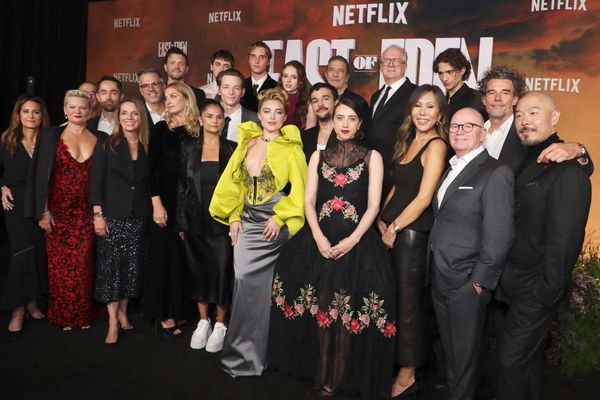
East of Eden is one of John Steinbeck’s seminal American classics; a biblical allegory dressed up in family feathers; a love letter to California’s Salinas Valley; and a warning to America to choose its destiny a little bit better (no one listened, lol). In 1955, Elia Kazan directed a film adaptation that, notably, served as James Dean’s debut role as a leading man. Before that, in 1952, Kazan testified at the height of McCarthyism to the House Un-American Activities Committee, naming names and destroying lives and livelihoods in the process. In 2026, Kazan’s granddaughter, Zoe Kazan, brings a new adaptation of East of Eden to Netflix as a prestige drama series.
Zoe Kazan’s East of Eden is different from Elia’s, by virtue of being longer but also by shifting the focus away from the tortured teenaged brothers, Cal and Aron Trask, to their parents, Adam Trask and Cathy Ames Trask. Zoe’s Eden is broader and deeper, she has more room to maneuver and more margins to draw in than a feature film allows. Elia turned East of Eden into a film about teen angst disguised as the Cain and Abel myth; Zoe widens her narrative lens to look more at generational trauma and cycles of behavior. It makes sense, while she doesn’t make her family business the focus of the adaptation, she doesn’t ignore it, either. Zoe Kazan’s East of Eden is VERY concerned with what one generation owes another. (She lightly addressed this in an interview with Vulture.)
Zoe’s Eden plays across seven episodes and revolves around two primary characters. Florence Pugh is simply outstanding as Cathy, who sees the ill in everybody to the point of nihilism. Cathy simply cannot accept that people contain multitudes. Her worldview is that everyone is bad, everyone does bad, everyone will always do bad, forever. There is no goodness, there is only bad, pretending. Cathy’s perspective is undoubtedly shaped by the heavily implied molestation that occurs when she is a very young child. Maybe there was always a kernel of something in Cathy, some meanness that was born into her, but her childhood experience warped her, bent her around something she could not name or process and so it grew, unchecked and ugly, until it becomes her only character trait.
Counter to Cathy is Lee, portrayed with extraordinary depth and sensitivity by Hoon Lee, an American-born man of Chinese descent who works as a servant in the Trask household in Salinas Valley, California. Lee code-switches constantly in the Trask household, speaking pidgin English and shuffling his steps around white people, but in the company of those he trusts—still white but at least more familiar to him—he speaks in perfect English and doesn’t hunch or shuffle. Lee is trapped by circumstance, an Asian American man in a time and place that has no understanding of that dual identity, limited by blatant anti-Asian sentiment and even official laws, and left to construct a life out of the detritus of the Trask family.
The first episodes of Eden are concerned with Adam (Christopher Abbott) and his half-brother, Charles (Mike Faist), who are raised by their strict, Civil War-veteran father (Tracy Letts). We see the forces that shape Adam and Charles, mostly at the direction of their father, but also that Adam is innately more sensitive than Charles, who has a temper and yearns for a life beyond the family farm. Their dad, naturally, sends Adam to fight in the Indian Wars, and traps Charles at home on the farm. This works out atrociously for everyone involved for several generations.
Cathy appears on their literal doorstep—shoutout to Zoe Kazan for lowkey making East of Eden a ghost story, by the way—and while Charles is immediately wary of the wounded woman, Adam pities her and nurses her back to health. And marries her and whisks her off to California even though she drugs him to sleep so she can f-ck his brother and blatantly tells Adam she does not want to go to California. This also works out atrociously for everyone for several generations. In this entire three-generation saga, not one good decision is ever made by anyone.
The later episodes take place after the turn of the 20th century and while the focus remains primarily on Cathy and Lee, we do get to meet Cathy’s and maybe Adam’s but probably Charles’s sons: the twins Cal and Aron. Zoe Kazan smartly keeps the focus on Cathy, Lee, and to a lesser extent Adam, as Cal and Aron are the ground where her grandfather trod, but it also frees actor Joseph Zada from James Dean’s shadow. Zada’s Cal doesn’t have to carry the story, and the overall focus is much less on teen angst and more on the intergenerational spiritual war being waged in the Trask family. Cal is just one more soldier in that war, not representative of an entire generation’s angst. His performance is lovely and fully stands on its own, you will forget James Dean played this same part, which is the best-case scenario for everyone involved.
It’s Lee who introduces the notion of timshel to the Trask family, the Hebrew word translated as “thou mayest”, invoked in the story of Cain and Abel from the Bible. Lee says the King James Version of the Bible translates God’s words to Cain as “thou shalt”, meaning an order is given to conquer sin. But the direct Hebrew translation, Lee says, is “thou mayest”, not an order but a promise of promise. That God’s words to Cain are not a directive but a reminder that whatever he has done, Cain still has choices, he has agency and free will, he can choose something different next time.
This is the fulcrum around which Zoe Kazan’s East of Eden revolves. Adam and Charles act as animals bound in the traps their father laid for them, driven apart and to opposite ends of the country by the roles their father gave them. Adam responds to every adversity, no matter its scale, as if the outcome is predetermined, with the doleful listlessness of a rabbit who knows it is ensnared. Cathy, too, behaves as if because she believes herself to be mean and cruel, then she must be mean and cruel. Charles is much the same, even declaring “kind recognizes kind” when warning Adam about Cathy.
Later, Cal struggles with his own nature, sensing a meanness in himself and frequently losing his temper and lashing out at his loved ones. He is the embodiment of “timshel”, as he is torn between what he senses is his base nature, underscored by discovering his mother is a notoriously vicious madame who blackmails powerful men, and his desire to be good, like his brother. But, as Lee reminds him, wanting to be good isn’t enough, it is his actions that matter most. If Cal is to be better, he must act better. But part of that is on Adam, too, not mirroring the mistakes of his own father but finding it in him to nurture Cal better than he, himself, was nurtured.
Zoe Kazan is the sole credited writer of every episode of East of Eden but for one, “Departure”, which is co-written by Alexander Chee (that episode focuses on Lee, and it was smart of Kazan to know when to bring in a collaborator). She doesn’t make the whole thematic focus of the show about her family, the themes are primarily broader and more generally about generational trauma, but throughout Eden she is wrestling with legacy and how one generation can break away from another in meaningful ways without fully torching the family bridge. It’s hard to ignore her own family context, and she never shies from it. If you’re aware of the Kazan family history, it lends a metatextual depth to the series, but if you don’t, you won’t miss anything. East of Eden is East of Eden, it stands just fine on its own. The Trasks have enough problems for everyone.
East of Eden is now streaming all episodes exclusively on Netflix.