America’s Sweethearts deserve fair pay, too

– 5 min read

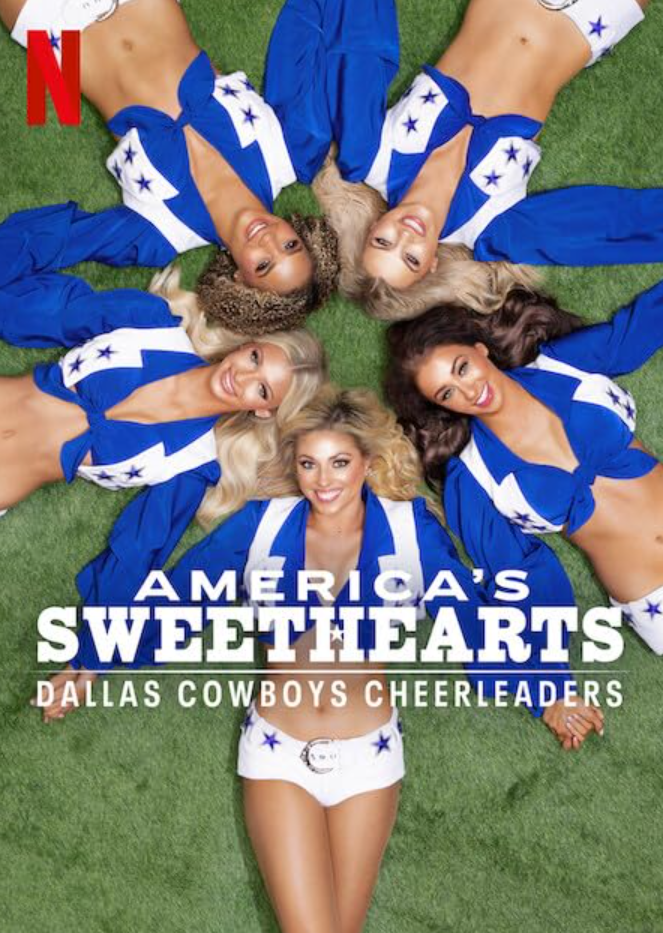
It didn’t take long for me to become immediately engrossed in the new Netflix series, America’s Sweethearts: Dallas Cowboys Cheerleaders. Am I a cheerleader? No. Am I from Dallas? No. Do I watch football? No. And while I’m known to love reality TV for all of the fights and drama, there was none of that in this series, yet it was still so appealing to me.
I was fascinated by the fly-on-the-wall perspective into the gruelling process of being selected as a Dallas Cowboys cheerleader (DCC). Getting to see the anxiety women (rightfully) experience in every step from crafting their audition routine, to practicing, to having to leave their families in some cases, and the sheer dedication it takes to become one of the Dallas Cowboys cheerleaders. But seeing all of that, only to learn that these women are not being compensated fairly in exchange for putting their bodies, mental health, relationships, and jobs at risk was what really kept me hooked.
The format of this docuseries follows the full, agonizing and antagonizing process of what it takes to be selected as a DCC. It follows the careful selection that narrows down a group of hundreds of women to just 36, who take the field at each Dallas Cowboys home game.
Throughout the docuseries, you learn about the origins of the DCC. Back in 1960, Cowboys manager Tex Schramm concluded that football was so much more than just a sport, but also a form of entertainment. With that in mind, he hired a bunch of beautiful women to be on the sidelines. Twelve years later, he pivoted, hiring cheerleaders, instead, dressed in the unmistakable uniform we still see to this day. And when cheerleader Gwenda Swearingen looked directly into the camera and winked, the Dallas Cowboys Cheerleaders were officially born.
The docuseries follows director Kelli Finglass and choreographer Judy Trammell as they conduct multi-round auditions, judging hopefuls, which include new applicants and veterans, on their precision, kicks, splits, facial expressions, makeup and hair. If selected to be among the 70 brought in for individual auditions, the women are required to undergo a makeover. That means a complete change to their aesthetic without even having made the team yet.
Early on in the series, though, it’s revealed that NFL cheerleaders don’t make much. That’s putting it gently. According to an NBC Sports Boston report in 2022, it’s estimated that NFL cheerleaders earn between $75 to $150 per game. That works out to be an annual average salary of $22,500.
To compare, even mascots make more than that. That’s no shade to mascots, but you can bet your last dollar the role of a mascot is not nearly as physically dangerous or demanding as the role of a cheerleader is. Even so, they bring in a marginal amount more, about $25,000 annually. Waterboys in the NFL make more than double that, raking in about $53,000 annually. And while cheerleaders who make public appearances can certainly charge, the fee is typically nominal and ranges from about $50 to $75 each appearance.
According to this Huffington Post article, there’s a running joke among DCC members comparing their salaries to the income of the players that goes as follows:
“The guys on the practice squad, who don’t even touch the field half of the time, are getting 80 grand more than we do a year. And I’m at every single game, dancing my ass off, and every other appearance, and my face is all over The Star. You don’t even know who these guys on the practice team are.”
Against the backdrop of these numbers and the varying degrees of difficulty and demand in the roles, it’s estimated that members of the DCC, on the other hand, are among the highest-paid NFL cheerleaders. According to the same NBC Sports Boston report, they earn about $15 to $20 an hour, or $500 per game, an annual salary of $75,000. But according to the series director, Greg Whiteley, he says he “never got a clean answer” about what the cheerleaders earn, speculating that it mostly has to do with seniority.
For context, the average annual salary in Texas is just over $50,000. So, the women are technically above average. But passion is a hard thing to place a value on, and perhaps that’s why it’s exploited so much, especially for women who have spent their lives dreaming of nothing more than storming the field and doing the routine to ACDC’S Thunderstruck.
It makes sense that the conversation surrounding compensation has completely dominated most of the chatter about the series. Yes, the competition aspect is interesting to watch, but the juxtaposition of the work they put in compared to their compensation is astonishing.
As word continues to get out about how little NFL cheerleaders make, many have spoken up, advocating for not just better pay, but better working conditions, and filing lawsuits. According to The Guardian, many of these have been settled privately. And of course, the Dallas Cowboys response to their measly compensation is about passion. Charlotte Jones, chief brand officer of the Dallas Cowboys told Netflix cameras that the cheerleaders “don’t come here for the money”.
"They have a passion for dance. There are not a lot of opportunities in the field of dance to get to perform at an elite level. It is about being a part of something bigger than themselves.”
Depending on your lifestyle or career, $75,000 can sound like a decent amount of money. But even with that, many of the cheerleaders profiled in the docuseries still have to work multiple jobs. And in order to work another job, even that has to be planned masterfully as rehearsals take place late into the evenings, after some of the women have already worked full shifts. Some cheerleaders work in dental offices, others in flower shops, others as registered nurses. They also put in about 30 to 40 hours a week practicing with the team, and who knows how many hours they put in practicing alone in their rooms, particularly during the final selection process.
To me, this really is about the exploitation of passion, which, for women, can make you extra vulnerable. We’ve seen it with the Miss America and Miss Universe pageants, where women are subjected to racism, bullying, poor treatment, poor compensation and even sexual harassment in the name of earning a highly-coveted title. In 2016, the Cowboys settled with four cheerleaders for $2.4 million after a senior team executive was accused of taking photos of them in the locker room undressing.
All of this speaks to the importance and impact of storytelling – particularly in the format of a documentary or a docuseries. Yes, this is entertainment. But it’s also peeling back the layers of what is very much a labour story. Documentaries and docuseries are becoming increasingly difficult to produce because the resources and platforms to do so are depleting. And the resources that are left are reserved for stories like this – ones that feature and centre mostly white people.
This docuseries being mostly about white people doesn’t render the point of the docuseries null and void. And to be clear, there is still inherent value in the information and entertainment that was presented to us through it. But with questions surrounding whether this series will get a second season, I can’t help but wonder if we’ll also start to hear the stories about Black cheerleaders being told. About the women who had to fight the racial barriers, too. Because those are the stories we always seem to lose first.