Indy the dog in Good Boy

– 3 min read

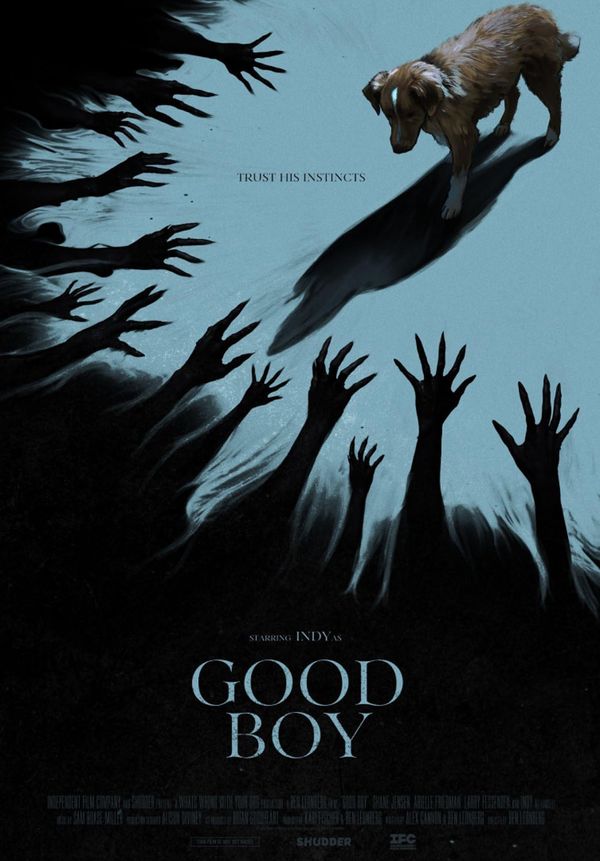
What does a dog see? When your dog stares into a corner, or peers into the dark, still and silent but for a quivering nose, what does he see? What does a dog perceive? When we’re sad, when we’re hurting, what does a dog understand of our emotions, how does he understand the world around him? Ben Leonberg’s feature film debut, Good Boy, shows us a world from a dog’s perspective, casting his own Nova Scotia duck tolling retriever, Indy, as himself in a horror movie that posits the world around dogs can be very scary, indeed.
Indy, the goodest boy, loves his person, Todd (Shane Jensen). But one night, sleeping on Todd’s legs, Indy is roused by shapes and shadows looming in the corner. And then comes rude reality: something is wrong with Todd. When Todd is released from the hospital, Indy is overjoyed, he is equally excited to go to the country and live in a new place with Todd. But at this new house, the shadows loom, and shapes lurk, and something is in the basement, and there is another dog haunting the house, and maybe something in the forest, and what is wrong with Todd?
Putting the camera almost entirely at Indy’s height, Good Boy shows us the world from his knee-high perspective. (The film is lensed by cinematographer Wade Grebnoel.) The camera often only focuses on certain things, darkness expanding and the world shrinking to Indy’s immediate surrounds. Todd is a giant, mostly legs and hands, the bits that touch Indy the most. The house, which once belonged to Todd’s grandfather (Larry Fessenden), is full of strange sounds and smells. The forest is a vast unknowable space, Indy’s focus usually shifts to small points of interest, such as a log. The world is too big for Indy’s comprehension, so he stays close to Todd, Todd is the center of his universe.
This does mean that Good Boy is sometimes disorienting. Indy’s perspective means we don’t always see the whole picture, or there is too much visual information to process, and scenes can become overwhelming and jumbled, or even confusing, as it seems like we just missed something—because Indy didn’t understand it. The story coalesces, though, as shadows creep ever closer and a monster begins to solidify; Indy is on guard against these things, though he does not understand what they are. But there are context clues for us humans. Ben Leonberg, co-writing with Alex Cannon, peppers enough information into the script that we can piece together the story pretty easily. Tension arises between our understanding and Indy’s, though, as the dog struggles to understand why his world is changing so much and so fast, and for us there is a little puzzle fitting together the pieces of information gleaned from Todd’s conversation and what Indy understands instinctively.
As a protagonist, Indy is incredible. His expressiveness and obvious intelligence work well for the film—it’s clear he’s a smart dog, but that only emphasizes the places where his comprehension fails. Too many things are happening that Indy doesn’t understand, and he becomes more agitated as the film progresses. But at a tight 73 minutes, Good Boy doesn’t push its premise beyond its breaking point. The actual progression of time in the film is a little confusing—it’s not like Indy is keeping track—but it simultaneously feels like everything happens in a few days or maybe several months. Time doesn’t matter, though, what matters is that Indy is on guard, determined to protect Todd from whatever is in the basement.
Good Boy is a great horror movie—tense, scary, featuring some A+ creepazoids. With its wooded autumnal setting, it’s a perfect spooky season watch. But really, it’s a love letter to the bond between humans and dogs, told from a dog’s perspective. If you’ve ever loved a dog, Good Boy is almost painful, to think about how a dog perceives our interactions, what to us is a casual pat is to them an ecstatic moment. And to think about how scary the unknown is to a dog, how they process what we endure with no real understanding of context or change.
Indy doesn’t need to be dealing with ghosts, he has enough on his plate with Todd’s increasingly mercurial moods. But Good Boy shows how dogs tether us to earth, to ourselves, how their love is constant, no matter what we say or do. Dogs will go to hell for us, and we can be so cavalier with their affection. Maybe we don’t deserve dogs, but Good Boy is about their unconditional love, not ours. Indy is willing to slay monsters for Todd, because he loves Todd. That is Indy’s whole world. “Good boy” isn’t an endearment or a reward, it is Indy’s calling. He IS a good boy. That is all. That is everything.
Good Boy is now playing exclusively in theaters.