Train Dreams: In praise of a life lived small

– 3 min read

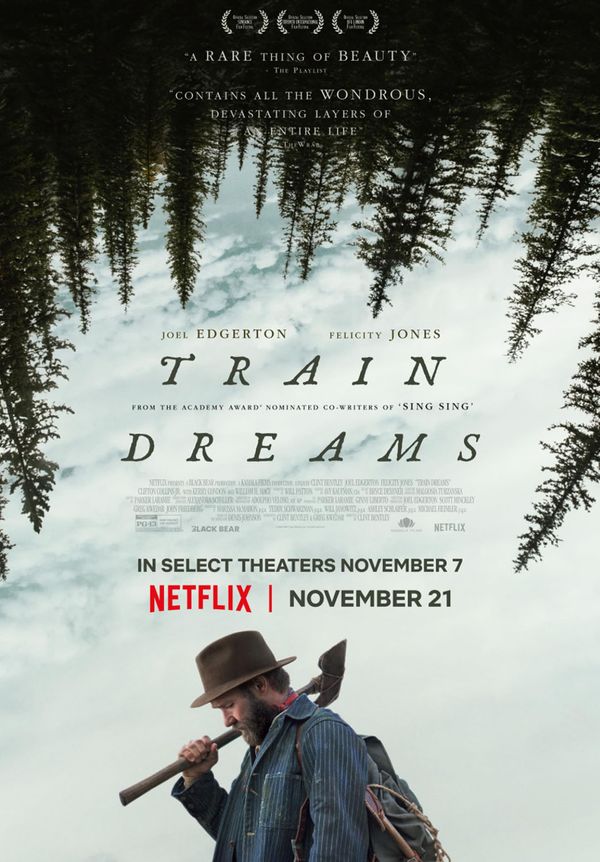
In Clint Bentley’s Train Dreams, an adaptation of Denis Johnson’s novella of the same name, the scope is wide, but the focus is small. The film, adapted by Bentley and Greg Kwedar and narrated by Will Patton—who has such a perfect voice to narrate a neo-Western, he also narrates the audiobook—we are introduced to Robert Grainier (Joel Edgerton), and informed that he spent over 80 years, most of his life, living in and around Bonners Ferry, Idaho. He arrived as an orphan at either six or seven years of age, and his life straddles the 19th/20th century divide in America. After an aimless youth, he meets Gladys (Felicity Jones), they marry, build a cabin, and have a baby, Kate.
Joel Edgerton gives a performance of full physical embodiment, in every frame he looks like a man carving his life from the forests of the Pacific Northwest. Robert works on the railroad, which he does not like. At one point, he witnesses his friend, Fu Sheng (Alfred Hsing), murdered for no reason (the early portions of Robert’s life are marred by anti-Chinese violence, which only lessens as do the Asian faces in the crowd). He also works as a logger, clearing vast swaths of forests to feed the manifest American machine. A fellow logger, Arn Peeples (William H. Macy), calls felling ancient trees “rough work” that “upsets a man’s soul”. But Robert labors on, bringing home rolls of cash for his young family. He and Gladys dream of building a sawmill so that Robert does not have to travel so far from home for work.
It is not to be, and much of Train Dreams is about the life that comes after dreams die (the film’s title refers to the dreams that plague Robert, of trains ablaze, ready to crush him). It is a tragedy, no question, but the world does keep turning, and Robert wakes day after day, a widower and childless father who must, somehow, keep going. To that end he has Ignatius Jack (Nathaniel Arcand, lowkey stealing scenes), a kindly Native man who ensures Robert has food, friendship, and work when he wants it.
There are also a feral dog and her puppies, which he cares for in the cabin he rebuilds. Robert’s life continues on, though the nature of his work changes as machinery turns logging into an even rougher, less companionable trade. He then begins driving a wagon to and from town, ferrying people where they need to go that cars cannot, at this point, reach. That is how he meets Claire (Kerry Condon), a member of the fledgling US Forest Service, who offers Robert more morsels of kindness and companionship to keep him going.
Train Dreams is not about big lives in the big west. Robert’s life is simple, small, defined by a series of tragedies he puzzles over for decades at a time. The west is already half dead by the time he gets there in the latter portion of the 1800s, and it dies utterly as he struggles to put a life together. There is nothing grandiose or noble about Robert or his life. He is just someone who lived in this period, witnessed everything from the building of a ground-breaking railroad bridge to the concrete highway that replaced it. Edgerton’s performance is equally plain, not overly emotive but Robert moves through life with a quizzical expression, as if constantly working out his place in the world, and maybe why the world seems to have it out for him. He’s done nothing of note, after all.
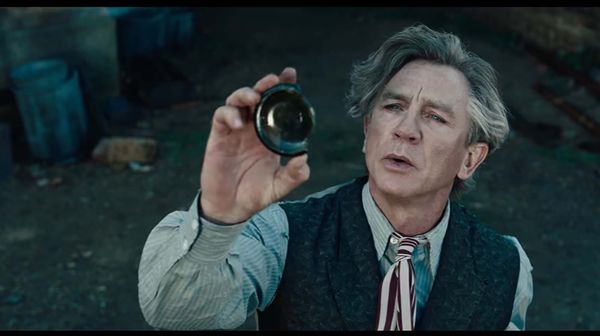
Bentley’s filmmaking, however, is not simple. Train Dreams is a lushly realized film (lensed by cinematographer Adolpho Veloso), shot in an engrossing, immersive 1.43x1 aspect ratio, which is taller than it is wide (Sinners also utilized this aspect ratio this year). The effect is a frame that towers over Robert just as the trees he harvests. The world is immense, he is but one small part of it, and Bentley’s frame reinforces both the beauty and staggering hugeness of the natural world, and Robert’s small life within it. Filmed using a combination of digital cameras and vintage lenses first used on film cameras, Train Dreams is proof that digital cinematography is not inherently ugly. It can be every bit as beautiful and evocative as celluloid, and at times Bentley’s visuals take on a Malickian meditativeness. The film is also backed by a score from Bryce Dessner and original music from Nick Cave, which adds a sepulchral depth to the narrative.
There is no great revelation in Train Dreams. There is no great battle, not even an enemy to fight, except for the harshness of life, which we all must experience. Robert wins nothing, some might say he accomplishes nothing. Robert is just a guy who lived in a place. His life is unremarkable, his death unnoticed. But he is as great a cinematic hero as any, a man whose life encompasses the joys and tragedies that connect us all. In his averageness, Robert is no one and everyone.
Train Dreams is now streaming exclusively on Netflix.