Glen Powell in The Running Man

– 4 min read

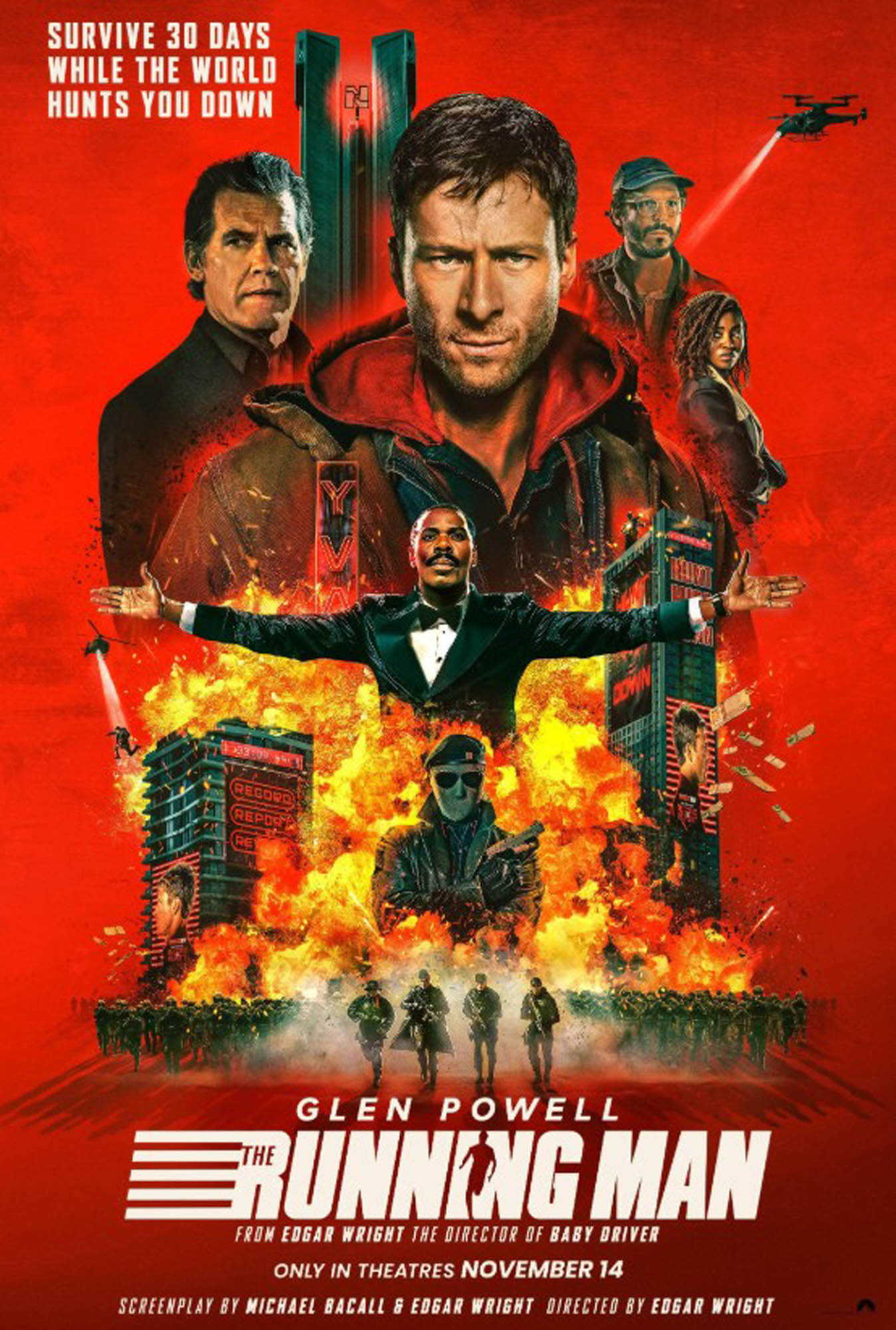
Stephen King released The Running Man in 1982 (under the pseudonym Richard Bachman), a dystopic novel set in 2025. Now, in actual 2025, Edgar Wright brings a new adaptation of The Running Man to the big screen.
Starring Glen Powell as beleaguered working-class hero Ben Richards, The Running Man is now set in the near future, though they could have just left the setting as 2025, frankly. That was probably too political for distributor Paramount, though, as that might encourage people to more closely examine how a dystopic vision from forty years ago pretty well nails our current reality.
Ben Richards is a good if angry guy, perpetually down on his luck in a socio-economic system designed to nurture a permanent underclass. Ben has been blacklisted from all jobs because he reported radiation exposure to his union, and this leaves him and his family on the brink of calamity. His daughter, Cathy (played by twins Alyssa and Sienna Benn), is ill, and his wife, Sheila (Jayme Lawson), works as a waitress to earn extra cash while her husband is out of work. But she’s not a sex worker! Don’t you dare imply that! Even though she is in the book, whatever, this is just one of several instances in which The Running Man backs down from King’s bleak vision for being too harsh.
Hoping to buy his family’s way out of crushing poverty, Ben signs up for The Running Man, a reality show in which “runners” try to survive while being chased by Hunters, who work for the network that airs the show. Also, regular citizens can earn money by snitching on runners, so literally nowhere is safe for a runner like Ben, because everyone is desperate for extra cash. On the run Ben goes, and he tries to expose the network’s manipulations of the game through his mandatory daily vlogs, but the network just replaces him with deepfakes whenever he says anything inconvenient. Stephen King really nailed the worst potential of the future back in 1982.
The script is co-written by Edgar Wright, who also directs, and Michael Bacall. The first half is mostly solid, but the film has two huge issues that not even Glen Powell working his Tom Cruise-light charm can overcome.
The first is an insane amount of exposition. Even in scenes when Ben is alone, and probably should be silent, he provides a running commentary, and several times throughout the film, everything comes to a halt so that a character can info dump for the benefit of no one, or, worse, narrates everything we’re watching on screen. It’s a cacophonous amount of exposition and it HAS to be a studio note, the exposition is so egregious and overbearing. Edgar Wright is usually more elegant than this. You know it’s a problem when exposition ruins the flow of an Edgar Wright joint.
The second crippling issue for the film is the ending. I won’t give it away, but suffice to say, it’s dumb and obvious and dumb. The book ends with a plane crashing into a skyscraper, and I can certainly understand a mainstream American film choosing to do something else, not least because of inevitable September 11 comparisons. But what The Running Man does instead isn’t swap out one catastrophe for another, it rewrites King’s ending entirely, providing a note of hope that the story does not earn in the slightest. Again, it feels like a studio note. Obvious wigs make the ending seem even more like a late addition.
Don’t get me wrong, there are fun and good elements in The Running Man, largely down to the appeal of Powell, and his co-stars Lee Pace—even under a mask he’s wildly entertaining and watchable—Josh Brolin, and Colman Domingo. Not faring as well, though, are the women, who are afterthoughts. Ben’s family exists solely to be imperiled to give him even more motivation, never mind the optics of a white guy repeatedly pledging to save his Black wife and child, which the film does not address at all. The Running Man feels so specifically neutered, you can practically hear some studio exec panicking at the idea of releasing a blatantly anti-capitalist film in 2025 (something numerous people have done this year).
But The Running Man plays into a lot of bad stereotypes without introspection. There is Ben’s unexamined white savior complex, and then there is Amelia (Emilia Jones), a nice white lady who buys into all the propaganda shown by the network. It’s not until she sees how Ben’s messages are manipulated for herself that she starts to believe something is amiss. A white woman needing first-hand experience of hardship before she cares about the lives of others? In THIS economy? Yes, of course, but the film doesn’t want to touch the obvious real-world parallels with a ten-foot pole.
Glen Powell remains an immensely charming screen presence, and it’s a testament to his star power that The Running Man works as much as it does. But the hammering exposition, the thin stereotypical characters, particularly the women, and the extremely obvious case of political fear plaguing the film bog The Running Man down in too many problems for even Powell to overcome completely.
It’s interesting to compare this film to The Longest Walk, another “Richard Bachman” novel by Stephen King centered on a brutal reality show with a cash prize which was adapted as a film this year. That film is fearless in its vision and mean as hell in its execution (no pun intended). It’s proof that The Running Man didn’t have to be this way, and you will never convince me this is the film Edgar Wright set out to make. But it’s the film we got because somebody somewhere got scared.
The Running Man is now playing exclusively in theaters.