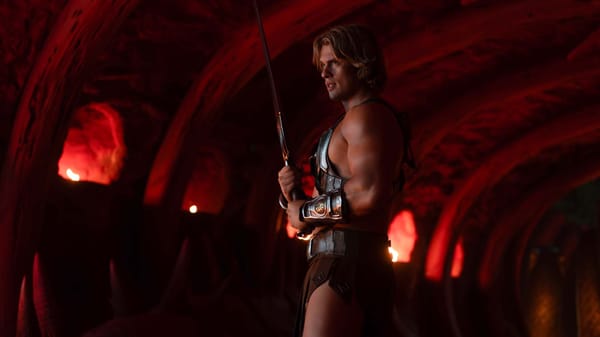
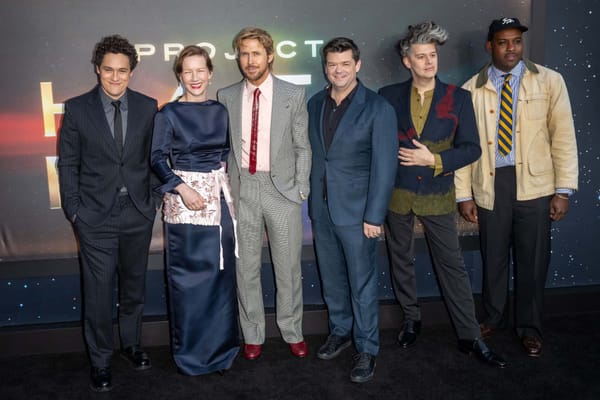
Greta Lee (and Jared Leto) in Tron: Ares

– 5 min read

Tron is a film and a franchise that has always looked far into the future while aging into its themes and ideas. Tron introduced groundbreaking visual effects to cinema in 1982, and Tron: Legacy repped the biggest and best effects of 2010; both films imagined a future with virtual reality and artificial intelligence. The third film in the franchise, Tron: Ares, is the first Tron that looks and feels of the moment, not ahead of it, but that is not inherently bad. While visually Tron: Ares lives up to its predecessors’ landmark style—this is one of, if not the best-looking films of the year—thematically Ares lives much closer to where we are now, pondering questions of humanity, personhood, and what is living when virtual reality is as acute as analog reality.
Picking up some years after the events of Tron: Legacy—Ares does not ignore Legacy, it just isn’t a direct continuation of that story—Ares stars Greta Lee as Eve Kim, a techno wunderkind who, along with her now deceased little sister, revitalized tech company Encom after Sam Flynn withdrew from public life. Don’t worry if you don’t know the Tron lore, Ares breezes through the highlights without getting bogged down in minutiae, and it is very easy to follow along. Mired in grief from her sister’s death, Eve is determined to complete her work by finding Kevin Flynn’s “permanence code”, which allows virtual constructs to survive in the real world indefinitely. Eve has humanitarian goals in mind—replicating crops, mass-producing life-saving drugs, and such.
On the other side of the chess board, though, is Julian Dillinger (Evan Peters doing his best Tony Stark impression). He wants the permanence code so that his AI-driven soldiers can be used in real world wars. The leader of these soldiers is Ares (Jared Leto, dialing it WAY down for once), a soft-spoken, inimitable warrior who gazes in wonder upon a firefly—that’s how you know Ares isn’t the mindless assassin Julian wants. That, and an understated but increasing distress every time Julian reiterates that Ares is “expendable”. The film, written by Jesse Wigutow and directed by Joachim Rønning, is mostly structured around elaborate chase sequences as Ares first tries to capture and then save Eve from Julian’s machinations to obtain the permanence code.
But it’s also not that cut and dry. Eve, for one, is no damsel in distress. Greta Lee is hugely fun and engaging as Eve, she gets to be a badass babe in a bitchin’ leather jacket, riding motorcycles and saving the day with her brain. And Ares has his own emotional journey as he literally gains emotions through his process of self-actualization. Leto’s performance is refreshingly straightforward and without bells and whistles, and it’s an annoying reminder that underneath all the Method actor bullsh-t, he’s really talented. Meanwhile, Peters reaches for ever more tyrannical and grandiose heights as Julian doubles down on bad idea after bad idea, and Jodie Turner-Smith is compelling as Athena, Ares’s second in command and rival. It’s a Terminator-esque performance but Turner-Smith throws in plenty of grace notes to suggest Athena’s inner life is developing along a parallel track to Ares.
Ares moves at a relentless place, clipping along at a tight two hours, and it’s a testament to the film’s themes and characters that I actually wish it were longer. There are big ideas and some acute observations rattling around in the film—Julian is basically every billionaire tech bro throwing humanity away for profit—but Ares keeps its entertainment foot forward at all times. The film never feels messy, but I missed a little of Legacy’s sprawl, of letting characters engage more and letting scenes breathe. That is in its own way a compliment—I want more of these characters, more time with them, more depth from them.
Because they’re on separate, if overlapping, journeys, Ares and Eve don’t spend too much time together just talking, which is a shame because their dynamic is fun and weird, and Lee and Leto seem to enjoy pushing each other as scene partners. It’s not exactly romantic but Ares is not not interested in Eve. Even though he only exists in the analog world in fits and starts, Ares is not a baby-brained virtual half-being, he is fully realized and has a maturity and understanding that suggests significant life lived in the virtual world of Julian’s grid, shaped by his forced servitude and fledgling emotional connections, one of which is with Eve after he studied her via her digital footprint.
He’s obviously fascinated by her intellect and her moral compunction, by her grief—which he has recently experienced for the first time himself—and, perhaps, by her belief that AI, like him, does not have to be inherently bad or dangerous. I wish there was more emotional interaction between Ares and Eve because as different as they are, they actually feel like equals. They each bring specific abilities to the table, neither one would be as effective without the other, and their relationship is grounded in mutual recognition and respect and fledgling trust. It’s a great character dynamic.
But Ares—and Ares—is always racing to the next set piece. And it is super fun and it looks AMAZING, though I have a lot of questions about how the visible light fields work, and Rønning’s direction is sharp and visually astute. As a Tron film should be, Ares is a mind-bending visual experience, enhanced by a sonic landscape designed by Nine Inch Nails. Another key feature of Tron is a killer soundtrack, and NIN delivers with a techno-industrial score and original songs that pair perfectly with Rønning’s more industrial design in this film. This is not a smooth, neon landscape but a burning industrial wasteland and NIN’s score emphasizes Ares’s grittier roots.
It is possible to simply experience Tron: Ares as a great time at the movies, a big, fun blockbuster heavy on style. But the themes are there, too, and as we saw with the previous Tron films, Ares will likely only grow in estimation over time. As the virtual world becomes ever more enmeshed with ours, it is inevitable to start echoing Ares’s questions about life, living, and permanence. And the difference between Kevin Flynn’s original grid and Julian Dillinger’s red-soaked hellscape poses questions about tech’s potential for harm, and whether or not Flynn’s utopian dream could even be realized in a tech space designed by humans. For a blockbuster, Tron: Ares has a lot on its mind, though its questions are open-ended. Ares finds no easy answers in the world of humanity, and neither do we.
Tron: Ares will play exclusively in theaters from October 10, 2025.
Attached: Greta outside GMA studios in NY this morning.