Stranger Things: Watchable Nostalgia Bait
The final season of Netflix's Stranger Things is still watchable despite its empty narrative and excruciating exposition-driven plot

– 5 min read

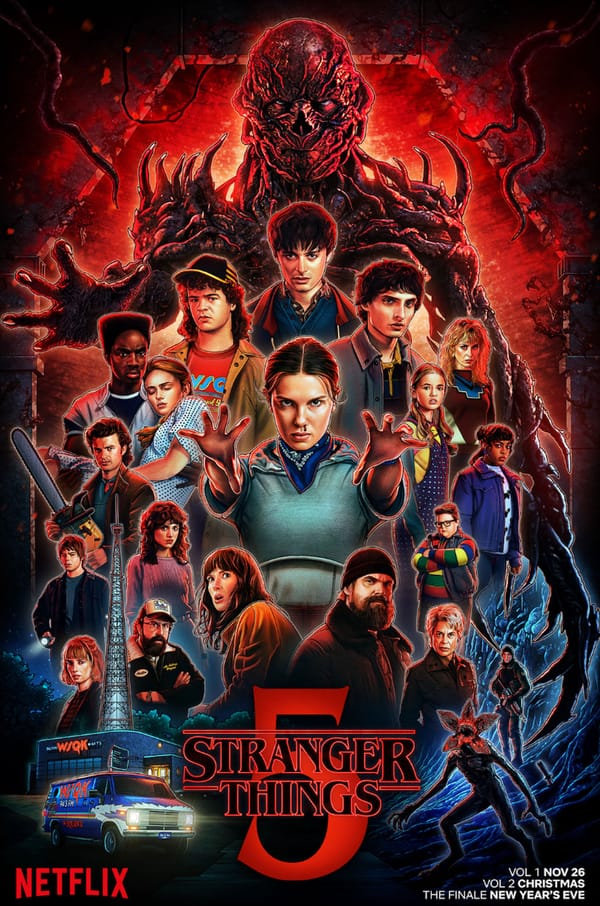
The final season of Netflix's Stranger Things is still watchable despite its empty narrative and excruciating exposition-driven plot
Spoilers ahoy!
Nine years after the adventure began, Stranger Things concluded its fifth and final season. As is always the case when a massively popular television show ends, people Have Strong Opinions about it, mostly of the negative variety. Here is my strongest opinion about Stranger Things: it’s fine, it’s totally mediocre. The finale has all the same problems the show has sported for years, some parts of it worked, others didn’t, it was a mixed bag, which is what Stranger Things has been since its second season. And hey, at least it’s not nearly as bad as the final season of Game of Thrones!
The chief issues with the wrap-up of Stranger Things are all the problems we’ve been seeing for years: it’s bloated, the pacing is terrible, the filmmakers value style over substance, a bunch of the young actors aren’t actually good at acting—what’s charming and precocious when you’re an actual 12-year-old is no longer cute or functional when you’re a full grown adult trying to play a kid—and, ultimately, Stranger Things is a show about nothing. There is no theme, there is no story, there is just a lot of plot and a metric ton of exposition. It’s just a series of fetch quests to get more things to get to the next thing to finally, maybe but probably not really, kill Vecna and the Mind Flayer…which takes all of ten minutes...
But STILL, it’s not a total loss. Some stuff does work in the final episodes. Joe Keery and Gaten Matarazzo turned out to be two of the strongest actors in the young bunch, so Dustin (Matarazzo) confronting Steve Harrington (Keery) over his tendency to make self-sacrificing maneuvers is an effectively emotional moment. You can see the years of trauma piled up on Dustin, and in that moment, Steve’s best care-taking instincts come out, comforting his friend and showing the growth Steve undertook over the years, from a self-involved bully to a man willing to do anything to protect those he loves.
Steve Harrington’s character arc is and always has been one of the strongest elements of the show, and the final episodes pay off his growth and give Steve an emotionally resonant send-off. (Side note: making Steve a schoolteacher/coach is perfect, because from the outside it looks like he peaked in high school, but we know, because we know everything he’s been through, that Steve discovered a real love of working with children and he is truly fulfilled by his role.) Similarly satisfying is Dustin’s final-season arc coping with the death of Eddie Munson. Unlike some other deaths (Barb), Dustin doesn’t just walk away from that event like nothing happened, and his grief is tangled up with teenaged loneliness and alienation. Dustin is a pill but his reasons for acting out are clear and motivated, so it only makes his eventual catharsis with Steve more satisfying when he’s finally able to shed some of that grief.
There are many things about the final season that I like, including the addition of Holly Wheeler (Nell Fisher), and in a world where villains are often an afterthought, Vecna is genuinely scary. Whether in human Henry Creel form or his walking dog food Vecna form, Jamie Campbell Bower infuses the character with palpable threat and menace. Bower excels at playing creepy weirdos, and here he gets to do that in multiple forms, and he brings some much-needed peril to the proceedings. Across these last two seasons, the writers and Bower built Vecna into such an effective villain that his boss, the Mind Flayer, actually feels like an afterthought. Like we didn’t need the Mind Flayer at all! I forgot all about the Mind Flayer because Vecna was such a scary dude I was only worried about him!
But the list of stuff that doesn’t work is, unfortunately, longer than the list of stuff that does. A knock on Vecna is that a deus ex rock-ina device undermines Vecna’s origin story a little, rendering him a puppet rather than a mastermind. This is sequel series setup bullsh-t, but that has been a problem for Stranger Things before (see also: season two’s “Chicago” episode and the character Kali). And then there’s all the bloat, with extremely long episodes stuffed with so much exposition the final season is mostly just one character using dumb props to explain the latest plan to everyone else. The dialogue across the final season is largely appalling because so much of it is just bad exposition.
Then there’s stuff like the Demogorgons and their demo-dogs, which are only as ever difficult to defeat as needed in the moment. So much of Stranger Things is style over substance, there is little consistency in threat levels because scene to scene, stuff is just happening for the sake of “this looks cool”. I am all for the “rule of cool” in screenwriting, in which you favor something cool happening over logic for the sake of pushing story forward, e.g., Maverick still flying fighter jets in the Navy long past the point he would have been forced to retire in real life, so that the plot of Top Gun: Maverick can happen. But what Stranger Things is doing is not “rule of cool” writing, it’s basing an entire plot on vibes. Sure, the action looks cool, but why is this happening, what are the stakes, why do I care? I can’t muster up much feeling for Karen Wheeler defeating a Demogorgon because it’s been years since Demogorgons felt like a serious threat. Anyone can beat one, as long as it looks cool.
But none of this shocks me or makes me think worse of Stranger Things at this point. I started thinking badly of Stranger Things around season three, when it became clear the show was sacrificing substance for style, and trading stakes for plot conveniences. The first season was nostalgic but not toxically so, the later seasons became solely about “’member berries” and reminding us of other stuff we’ve liked in the past. The show became meaningless, the cast was just likeable enough to keep watching for the fun and/or effective bits and pieces like guitar solos and Dustin’s meltdown. Stranger Things was never a total loss, there was always just enough good to keep it going, but it was clearly never going to be a show with any kind of heart or purpose. It’s just a hangout show set in spooky 80s vibes.
Because I expected so little from it, by the end I just wasn’t bothered by not getting more. I understand this sentiment will not work for many people, but I gave up so long ago I’m just not bothered by a mediocre-to-bad finale. It ended exactly as I expected—no real consequences (where did the military go???), no stakes, no meaningful losses. Even Eleven’s “ultimate” sacrifice is undercut in order to keep the sequel series door open. But that’s no more than I expected! At this point, Stranger Things’ meaningless, hollow finale exactly met my expectations for a meaningless, hollow show. I enjoyed some of the elements, and shrug off others as no better than this show has been doing for the better part of a decade. The time to be mad at Stranger Things for sucking was like six years ago.
That is where I leave Stranger Things. The final season is not the worst we’ve seen in recent memory, despite its empty narrative and excruciating exposition-driven plot, it’s still watchable, because it is stylish and the cast is fun. And because it the finale is so in line with the sh-tty writing, bloated storylines, and consequence-free action, it doesn’t even feel like a letdown, so you can go back and enjoy previous seasons without thinking about the ending as a betrayal of previous quality, because it’s not. Quality control left Stranger Things so long ago, really only the first season has it. Everything else is an unnecessary, profit-driven expansion pack that is, at best, a watchable piece of nostalgia bait. And that’s really all Stranger Things is, in the end. Watchable nostalgia bait.
Stranger Things is now streaming all episodes exclusively on Netflix.