The power of imagination in Toy Story 5

– 3 min read

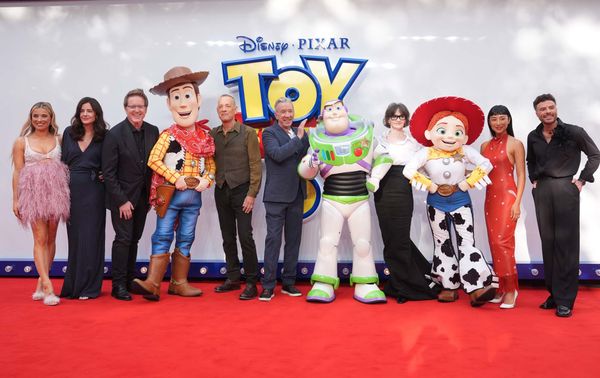
Thirty-one years and five films deep, the Toy Story franchise somehow keeps finding new ways to justify its existence. Seven years after Toy Story 4 asked what it means to live purposefully, the toys are back in Toy Story 5, which asks us to choose imagination when screens and devices make every aspect of our lives so flat and anodyne. Written by Andrew Stanton and Kenna Harris, and directed by Andrew Stanton, Toy Story 5 is not the pinnacle of the franchise, but it has all that Toy Story charm and heart that makes these films so enduring and endearing.
The toys still reside with Bonnie, the little girl who claimed them in Toy Story 4. Woody (Tom Hanks) is still living in the outside with Bo Peep (Annie Potts), rehoming “lost toys”. Jessie (Joan Cusack) is now in charge in Bonnie’s world, serving as the new sheriff since Woody departed the world of children for the world of toys. (I still have so many questions about how many objects are sentient in this universe. What’s going on with the toasters?) Bonnie (Scarlett Spears), however, is soon swayed to the dark side by a new tablet toy, a Lilypad called “Lily” and voiced with vaguely sinister, tech-smooth tones by Greta Lee. With Lily “helping” her, Bonnie soon finds some new friends, a trio of mean girls named Chelsea, Heidi, and Kara.
Toy Story 5 tackles the onset of digital toys and closes the loop on the technological advancement first represented in Toy Story. Back then, pull-string Woody was intimidated by battery-operated Buzz Lightyear, with his moving parts and flashing lights. Now, the toys are being fully replaced by Lily, a consuming portal of vacuity that consumes children like a dark god. Bonnie’s sh-tty new friends make fun of her old school toys, while Lily works to isolate Bonnie from her toys, too. In a world of Lilypad tablets, no one seems to see a need for imaginative toys anymore…except an animal-loving girl incomprehensively named Blaze (Mykal-Michelle Harris).
Technically speaking, there are some cool new touches in the animation, done by Pixar, who is the Lily to hand-drawn animation’s Woody and this film is as close as they’ll ever get to pondering their role in the minimization of hand-drawn animation. But Woody has a bald spot now, which is funny in two ways, because Woody is “getting old” but also, he is an old toy and shows signs of advanced wear and tear. Blaze’s hair is a leap forward in computer-animated texture, which should make animating Black characters better and more interesting going forward.
Narratively, there are lots of fun new things, too. Conan O’Brien voices a dying potty-training toy called Smarty Pants and Jessie goes on a harrowing side-trip to save his life—this franchise is really obsessed with nearly killing toys only to pull back at the last second (Toy Story Kill A Toy Challenge). And Jessie also has a rewarding emotional arc in which she realizes the long-term value of a beloved toy. Long after the child has grown up, fond memories remain and can impact the person the child becomes forever.
But there is one huge pitfall, one that is almost inescapable in 21st century cinema. Because Lily is a tablet, because so much of the plot revolves around technology and its pervasive creep into every facet of our lives, a lot of Toy Story 5 involves watching characters send and read emails. No one in the history of cinema to date has made reading emails—or texts—visually exciting, and Pixar doesn’t solve that problem, either. They try really hard by pushing the toys to devise plans to type messages and get humans to read them, which involves shenanigans of varying degrees and is, at most, cute. But at the end of the day, we’re watching people read screens on screen: boring. The toys find value in imagination, I wish more filmmakers would find value in not making us watch people open emails.
Overall, Toy Story 5 is a solid film. I don’t think these are really for children anymore, but for parents anxious about what devices are doing to children, it provides a motive for beefing up your kid’s toy chest. #5 doesn’t have #4’s absurd surrealism thanks to Forky—he is present but not essential—but the messaging about the power of imagination is potent in our device-driven, AI-flattened times. Toy Story has gotten very good at speaking to the generation who grew up on the original set of films. Toy Story 5, with Jessie as a central protagonist, is particularly good at speaking to horse girls. Oh my god, I just realized that’s why she’s named BLAZE.
Toy Story 5 is now playing exclusively in theaters.