Cristin Milioti in Buddy

– 3 min read

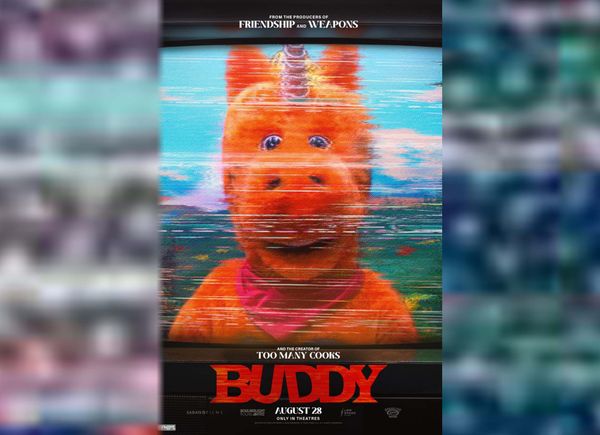
The backlash to the children’s program Barney & Friends is so historically severe it has its own Wikipedia entry. It’s mostly humorous, though rooted in real irritation at Barney’s annoying voice, the show’s saccharine, corny tone, and the horror older kids feel for anything meant for babies. Casper Kelly’s Buddy, featuring a bright orange unicorn that hosts a children’s show, stems from Barney’s well of discontent, though Kelly is also the writer/director of the short film Too Many Cooks, which uses 1990s sitcom opening credits to both spawn a horror story and explore how the banal face of family entertainment packages that horror to audiences.
Buddy is Kelly’s feature-length directorial debut—he also wrote the script along with Jamie King—and he’s still got the banality of family entertainment and The Dark Forces on his mind. Keegan Michael-Key voices Buddy, a goofy orange unicorn and the host of It’s Buddy!, a kids’ show in the vein of Barney & Friends with a dash of Pee-wee’s Playhouse surrealism. The film opens with an episode of It’s Buddy! in which Buddy leads his young friends in songs about bravery, and we meet the characters who fill out his world, such as a talking backpack called Strappy (voiced by Patton Oswalt), a helpful nurse (Phuong Kubacki), and Betty Bunny, a big pink bunny rabbit (voiced by Jemmica Collins).
The kids are led by Freddy (Delaney Quinn) and Wade (Caleb Williams), with nerdy Oliver (Tristan Borders) tagging along. There is also Josh (Luke Speakman), who refuses to play with Buddy. When Josh disappears from the second episode of It’s Buddy!, he is replaced without comment by Hannah (Madison Skyy Polan). But Freddy notices something is wrong and wonders what happened to Josh, and as another episode of It’s Buddy! begins, it becomes clear not all is well in Buddy’s playland.
On a production level, Buddy is brilliantly executed. It’s Buddy! looks like a real 1990s kids’ show, with its neon, ugly-on-purpose aesthetic. But in the real world, Buddy looks like a Nineties sitcom, too, even though people have flat screen TVs and slim laptops. But the home aesthetics of fraught couple Grace (Cristin Milioti) and Ben (Topher Grace) are very Nineties, with warm wood furniture, thick pile carpets, and clunky home décor. Buddy is very much an homage to Nineties family entertainment, even as it spins into something darker. Even the casting of Cristin Milioti and Topher Grace, sitcom stars in their own right, is a nod to this form of entertainment.
Grace is haunted by an absence she can’t name, and Ben is equal parts oblivious to and annoyed by his wife’s emotions. Meanwhile, Freddy and her friends are trying to survive Buddy’s surreal nightmare hellscape. Clint Howard pops up as George, an adult in too-small clothing from an earlier era, accompanied by a ventriloquist dummy brilliantly voiced by Michael Shannon. The suggestion that Buddy’s machinations have been going on for generations is horrifying, even as it creates a chain of cheesy children’s entertainment.
One of Buddy’s greatest strengths, besides its artistic design, is that The Lore is never explained. There are insinuations that Buddy has always existed in the TV landscape, there’s a hint of Something Bigger going on, but Buddy doesn’t get bogged down in those details. At no point does an adult show up to monologue about What It All Means. That’s probably for the best, as trying to explain Buddy would only ruin the horror of it all.
But a point against Buddy is that while Casper Kelly is clearly interested in the banality of anodyne entertainment and how it can paper over darker themes, he doesn’t effectively tie any of it together. The ideas are there, particularly that the lessons imparted in shows like It’s Buddy! can be meaningful, though the “obey” mentality expressed by Buddy himself, arguably conditioning kids to follow instructions without question, is destructive. Unfortunately, the climax doesn’t connect in a way that deepens the themes Kelly lays out in the first half of the film.
Buddy is provocative in ways bound to incite insipid commentary, and it will be telling in itself if people would rather take exception with Buddy’s provocations rather than look harder at children’s entertainment and ask what it really accomplishes. I admit, though, that I am curious about the kids who star in the film, how they were treated and cared for during production, and what on set protections, if any, were afforded them. Buddy itself begs these questions.
Buddy seems destined for cult status, its dead-on parody of Barney & Friends and its backlash—and its loving, if surreal, homages to more oddball children’s entertainment, like Pee-wee’s Playhouse—too perfectly executed not to be admired. I just wish it added up to more, that Casper Kelly’s ideas connected more meaningfully. Buddy feels on the cusp of truly inspired greatness and settles instead for shock schlock.
Buddy is now playing exclusively in theaters.