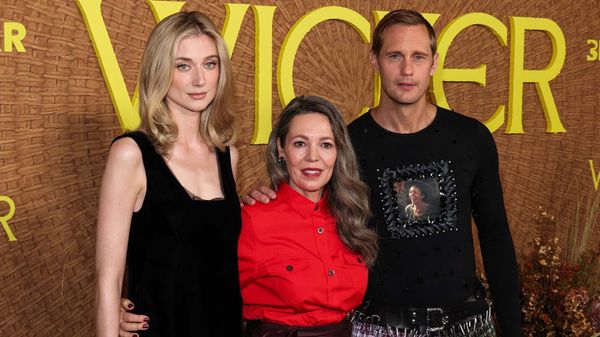
Olivia Colman and Alexander Skarsgård in Wicker

– 3 min read

In a medieval-ish time in an English-type village, no one seems to have proper names, and everyone is addressed by their job or their relation to a man. There is Doctor’s Daughter who is also Tailor’s Wife, there are Baker and Baker’s Wife, everyone in their place, labeled and discerned as a function of village life. There is also Fisherwoman, played with an acidic kind of vulnerability by Olivia Colman, who is something of the town outcast. She lives alone, she is homely and mocked for smelling of the fish she sells at market, she is the particular object of scorn of Tailor’s Wife (Elizabeth Debicki), who is blonde and bitchy and very tall.
But Fisherwoman absorbs these slings and arrows and keeps on with her simple life, until a mishap during a village wedding brings out one too many barbs from Tailor’s Wife and Fisherwoman asks the Basket Weaver (Peter Dinklage, particularly twinkly about the eyes) to maker her a husband. And so Fisherwoman marries her Wicker Husband, and the entire village descends into social chaos.
Wicker is directed by the duo of Alex Huston Fischer and Eleanor Wilson, who also adapt Ursula Wills’ short story for the screen. Wicker begins as a romantic comedy, with Fisherwoman interrupting the flow of life in the village with her strapping Wicker Husband (Alexander Skarsgård, who brilliantly combines physical stiffness with emotional softness). First, she eschews the rituals of marriage, for in this not-quite-reality, women are wed wearing collars instead of rings—putting the “lock” in wedlock. But Fisherwoman skips the collar, and her relationship is immediately notable for the parity of her partnership with Wicker Husband. He does domestic chores, he assists with her work, he is her helpmeet. Everyone in town notices.
Wicker is in turns a truly tender romance and a sharp social satire. The villagers are superstitious and judgmental—it’s extremely easy to imagine them burning witches in the village square—but they’re also suffering under an intense patriarchy that renders women objects to be possessed. Even men who love their wives struggle to express emotion and the Wicker Husband’s notion of doing things to help his wife to demonstrate his love for her is like a grenade launched into the socio-political order of the town. And no one takes it worse than the Tailor’s Wife, who is at once contextualized as an intelligent woman trapped in this repressive society, and a horrible bully who absolutely deserves the ending she gets. Because Wicker is, more than anything, a fairytale, and fairytales always have morals.
And yes, Wicker is horny, but not in a lascivious or exploitative way. The intimacy in Wicker reminds me of that in Heated Rivalry, in which sex is a means of communication that deepens a relationship in which words are not always reliable. Fisherwoman gets laid spectacularly, but the intimate scenes are at times funny, and at other times romantic, and while it is obvious they are having vigorous sex, the focus isn’t on the mechanics, it’s on Fisherwoman and how she blooms through attention, love, and affection. But she also struggles with vulnerability after a lifetime of bullying, and in the third act, Wicker takes a heartbreaking turn.
It’s an unpredictable narrative—assuming you haven’t read the short story—that takes unexpected turns and digs into deeper emotions than a film billed as “horny for Pier 1 Imports” could be expected to do. The touches of magical realism and Peter Dinklage’s theatrical performance add whimsy to a story that is rooted in real conflict and understandable fears. Anna Meredith’s score is heavy on reeds and strings and sounds suitable for a renaissance faire without coming across as cheesy, and there is a focus on the natural world that blends with Fisherwoman’s earthy existence and how close to the ground even the wealthiest citizens of the village live. It’s not full-on “Robert Eggers everyone looks like they have lice and smell like sh-t” territory, but there is enough dirt and muck and sweat and piss to remind us that the past was gross.
And then in its final minutes Wicker takes a horror movie turn that provides an extremely satisfying resolution. Truly this film is never what you expect and goes places that delight. Is it a gleefully horny sex romp? A little, sure, but mostly Wicker is a twisted fairytale centered on a lovely romance and a funny satire, with lessons about feminism, kindness, and learning to accept love even when you feel unlovable.
Wicker is now playing exclusively in theaters.