TIFF Review: Our Lady Peace honors fans with Gail

– 3 min read

Band documentaries can be as insipid as band biopics, glossy and polished and cutting away all the rough spots in favor of presenting a favorable, often self-aggrandizing view of the musicians. Not so in Gail, a documentary that is, ostensibly, about the 30th anniversary tour of Canadian rock band Our Lady Peace (whose hit single “Superman’s Dead” was inescapable in the late Nineties). But rather than follow the band on tour, Gail follows Gail Lichtman, a long-time OLP enthusiast who has seen OLP in concert more than one hundred times. Just don’t call her a fan!
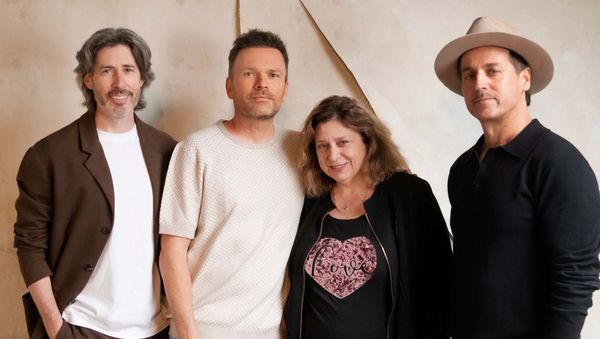
Directed by Michael Maxxis, with Jason Reitman and members of OLP on board as producers, Gail introduces us to Gail Lichtman as an irascible New Yorker who works the morning shift at New York’s MTA to build up her pension. She’s grumpy and a little unlikeable, but even at fifty-whatever and three decades deep into her love affair with Our Lady Peace, she lights up whenever she talks about the band and their music. Her favorite song is “Hope”, she has lyrics from it tattooed on her arm, she asks the band to play it every time she sees them, but they never do.
Gail connects with the band through expensive backstage meet-and-greets, where she waits last in line to guarantee that no one is hurrying her along when she gets her moment with the band. She rejects the label “fan”, preferring “friend” (though the film’s tagline is “More than a fan. Less than a friend.”), but she is, at least, very familiar to the members of Our Lady Peace: Raine Maida, Duncan Coutts, Jason Pierce, and Steve Mazur, who greet her fondly when she appears at their shows.
Social media has fueled a conversation about fandom and parasocial relationships, but Gail is a reminder that parasocial fans have always existed, it just used to be a lot harder to manufacture relationships with the artists we love. When Gail talks about working to juice her pension, then later states that she buys costly meet-and-greet passes at every concert she goes to, it’s hard not to wonder, over her thirty years of fandom, how much money she’s spent on Our Lady Peace. A lot, certainly.
The impulse to judge, though, is counterbalanced by the clear joy and comfort that the band’s music brings her. She has also made friends and built a community by following OLP on tour over decades, though she is now at the time of life when some of those friends are beginning to pass away. And Gail herself is struggling, she “did something” to her knee and must use a cane, and she has chronic pain from arthritis. In one direction Gail is an ode to music and the people who love it, in another it’s a sympathetic portrait of living with an invisible disability and chronic pain.
And in yet another direction, Gail is a love letter to Canada, too. Morgan Gold’s cinematography captures the sweeping beauty of Canada’s vast and varied landscapes, and the ugliness of its cities, highways, byways, snow muck, and rude people. Just as the documentary presents Gail at her best and worst, it shows all sides of Canada, too.
What Gail does not do is give us any real insight into Our Lady Peace, one of Canada’s signature alternative rock bands. The band is barely in the film, and their music is rarely used—though Maxxis saves his needle drop for a moment when it really counts—so don’t go in thinking you’re going to get an intimate portrait of the musicians. You won’t. But OLP’s history and impact are illustrated with thoroughness and humor through Gail’s collection of memorabilia, amassed from every concert she attended and music store shelf she scoured.
Gail is, as my brother—a huge OLP fan—said, a bit like American Movie but for music fans. It is certainly an unconventional band documentary, and an engaging, often funny, sometimes sad slice of life accounting of one deeply committed devotee’s dedication to the band that has brought so much to her life over the years. Gail is equal parts a reminder that the word “fan” comes from “fanatic”, but also of the power of music to shape our identities and keep time through the seasons of our lives.